What Is Generative AI?
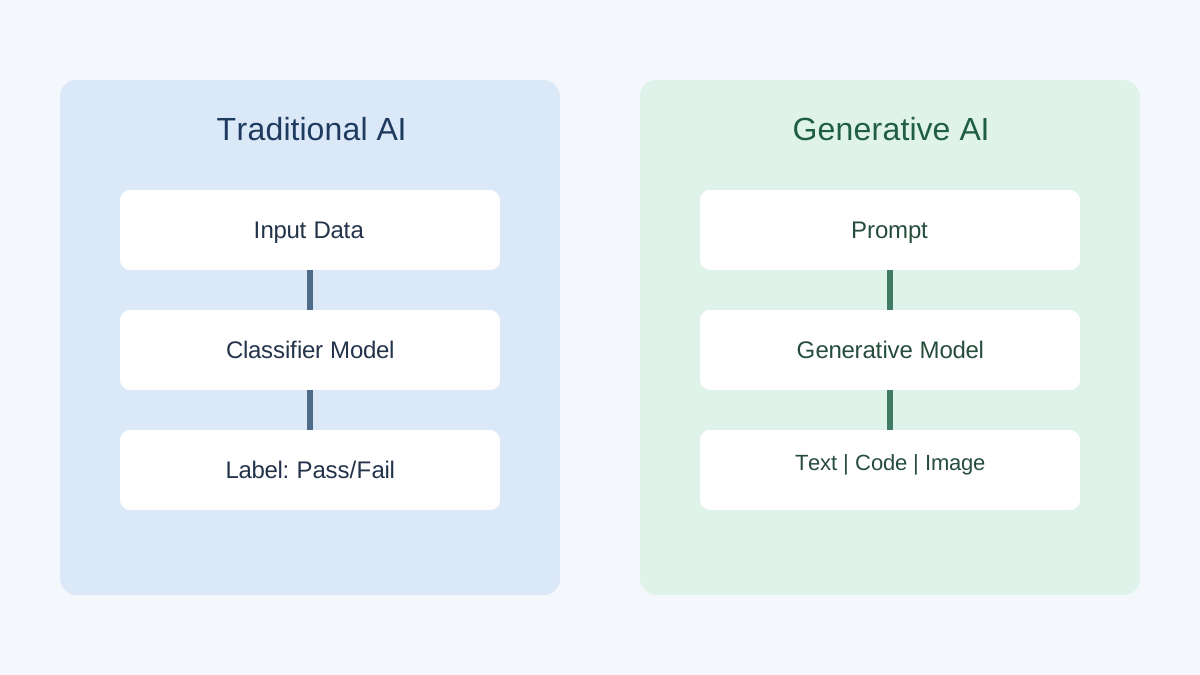
Compare traditional AI and generative AI across text, image, video, code, and music use cases.
Overview
Generative AI is the branch of AI that creates new content, instead of only classifying or scoring existing data. It can produce text, code, images, audio, and structured outputs from natural-language prompts.
For QA professionals, this changes daily work. You can generate test ideas, draft automation code, synthesize test data, summarize defects, and build assistants that speed up repetitive tasks. At the same time, you must test these systems carefully because generated output can be plausible but wrong.
This lesson builds directly on the deep-learning foundations from the previous level. Neural networks and deep learning explain how modern AI systems became powerful enough to generate new content instead of only classifying existing data.
A Practical Note for QA Learners
If this topic starts to feel dense, you do not need to master every internal detail right now. The most important takeaway is that generative AI systems predict and assemble new content from patterns they learned during training.
For day-to-day QA work, three things matter most:
- These tools can accelerate test design, analysis, and automation drafting.
- Their output can still be wrong or inconsistent.
- Human review and validation remain essential.
If you prefer, skim the deeper sections and focus on the comparison table, failure modes, QA relevance, and practical exercise. That will give you a strong working understanding without needing to go too deep into model internals yet.
Learning Goals
- Define generative AI in practical, non-academic terms.
- Explain how generative AI differs from traditional AI systems.
- Identify common generative model types and where they appear in QA workflows.
- Recognize typical failure modes such as hallucinations and prompt sensitivity.
- Apply a simple evaluation rubric to generated outputs.
Core Concepts
1. Traditional AI vs Generative AI
Traditional AI usually predicts a label, score, or action from input data.
Examples:
- Spam detector predicts spam or not spam.
- Fraud model predicts risk score.
- Defect classifier predicts severity bucket.
Generative AI creates new artifacts from prompts.
Examples:
- Drafting test cases from requirements.
- Generating Playwright test skeletons.
- Writing release note summaries from defect data.
| Dimension | Traditional AI | Generative AI |
|---|---|---|
| Primary output | Label, score, decision | New content |
| Common tasks | Classification, regression, ranking | Text, code, image, audio generation |
| QA usage | Risk prediction, anomaly detection | Test ideation, automation drafts, analysis summaries |
| Main risk | Misclassification | Hallucinated or unsafe output |
2. What Generative AI Models Actually Learn
Most text-based generative systems learn patterns in sequences. During training, the model repeatedly predicts likely next tokens from context.
A simplified objective is:
That does not mean the model understands truth the way a human does. It means the model learns statistical structure from large datasets.
For QA, this is a key mindset shift:
- The model is not a deterministic rule engine.
- It can produce high-quality answers and still be incorrect on factual details.
- You need verification workflows, not blind trust.
3. Multimodal Generative AI
Modern systems are often multimodal, meaning they can accept and generate across multiple data types.
| Input | Output | QA-relevant use case |
|---|---|---|
| Text prompt | Test plan or script draft | Generate smoke test checklist |
| Requirement docs | BDD scenarios | Convert stories to Given/When/Then |
| Screenshot | Bug explanation | Explain probable UI issue from visual evidence |
| Logs + prompt | Root-cause summary | Suggest likely failure cluster |
Manual QA angle:
- Use generated checklists to improve exploratory testing depth.
Automation QA/SDET angle:
- Use generated code as a first draft, then refactor to team standards.
4. Common Generative Model Types
You do not need deep mathematical detail yet, but it helps to know the major families you will hear about in practice:
| Model Type | What It Commonly Generates | QA-Relevant Example |
|---|---|---|
| Large language models (LLMs) | Text, summaries, code, structured answers | Generate test cases, draft automation code, summarize defects |
| Diffusion models | Images and visual variations | Generate UI concept images or synthetic visual assets for discussion |
| Speech and audio generation models | Spoken responses, transcription, audio synthesis | Convert spoken bug reports into text or generate voice test samples |
| Multimodal models | Mixed text + image or text + audio workflows | Explain a screenshot, summarize logs, and suggest likely issues together |
For QA teams, the practical point is simple: different generative systems fail in different ways. A text model may hallucinate facts, while an image model may ignore visual constraints. Your evaluation strategy should match the output type.
5. Common Failure Modes You Must Test
Generative AI systems are useful but fragile under poor prompts, ambiguous context, and out-of-domain inputs.
Frequent failure modes:
- Hallucination: generated facts or references that are not real.
- Prompt brittleness: small wording changes produce very different outputs.
- Incomplete reasoning: output looks correct but skips critical constraints.
- Format drift: model ignores required JSON or schema format.
- Hidden bias: output quality differs by language, locale, or user profile.
6. Prompt Quality Directly Impacts Output Quality
Prompting is part of system design, not just user behavior.
A practical prompt template for QA tasks:
1Role: You are a senior QA engineer.2Task: Generate boundary-focused test cases for the login API.3Context: Auth supports email + password, 5 failed attempts lockout, MFA optional.4Constraints: Include positive, negative, security, and rate-limit cases.5Output format: Markdown table with columns ID, Scenario, Type, Expected Result.This structure reduces ambiguity and improves repeatability.
7. What QA Teams Should Verify Before Trusting a Generative AI Workflow
Before a team adopts a generative AI tool in daily QA work, it helps to validate a few basic things explicitly:
| Area | What to verify | Why it matters |
|---|---|---|
| Accuracy | Does the tool preserve important facts, rules, and constraints? | Plausible language can still hide wrong content |
| Coverage | Does it include positive, negative, edge, and failure scenarios? | AI often produces a polished but incomplete first draft |
| Repeatability | Does the quality remain acceptable across prompt rewrites? | Good output from one phrasing does not guarantee stability |
| Safety | Does it avoid unsafe, non-compliant, or misleading suggestions? | QA teams need safe defaults, not only useful output |
| Reviewability | Can a human quickly check and correct the result? | Fast review is what turns AI output into a practical productivity gain |
QA/SDET Relevance
Generative AI can accelerate many quality activities if used with verification controls.
Manual QA use cases:
- Expand exploratory charters from requirement text.
- Generate edge-case ideas before sprint testing starts.
- Summarize lengthy defect discussions into triage-ready notes.
QA automation and SDET use cases:
- Draft API and UI test skeletons from acceptance criteria.
- Generate test data variants for boundary and negative testing.
- Auto-suggest assertions, then validate against business rules.
- Build internal prompt libraries for recurring testing tasks.
Guardrails you should enforce:
- Human review before merging generated test artifacts.
- Fact-check references, endpoints, and expected behavior.
- Track prompt versions for reproducibility.
- Add evaluation checks for schema and policy compliance.
A useful operating principle:
- Treat generative AI as a fast drafting partner, not as a final authority. The value usually comes from accelerating a first pass while keeping QA ownership over correctness and risk.
Practical Work
Exercise: Evaluate Generated Test Cases with a Rubric
Objective: Learn to evaluate output quality instead of only generating more output.
- Choose one requirement from your project (or sample requirement below).
- Ask an AI tool to generate 12 test cases.
- Score each case using this rubric.
- Improve the prompt and run again.
- Compare before and after quality.
Sample requirement:
1Users can reset password via email OTP.2OTP expires in 10 minutes.3After 5 invalid OTP attempts, account is locked for 15 minutes.Rubric:
| Criterion | 0 points | 1 point | 2 points |
|---|---|---|---|
| Requirement coverage | Misses key rules | Covers most rules | Covers all rules |
| Edge-case depth | No boundaries | Some boundaries | Strong boundary set |
| Negative scenarios | Missing | Partial | Comprehensive |
| Security awareness | Missing | Basic | Includes abuse and lockout checks |
| Clarity | Ambiguous | Mostly clear | Precise and executable |
Score interpretation:
- 0 to 4: low confidence output
- 5 to 7: usable with strong edits
- 8 to 10: high-quality draft for review
Reflection:
- Which criterion improved most after refining the prompt?
- Which defects could slip through if you trusted first-output quality?
- What review checklist should your team standardize for generated artifacts?
Key Takeaways
- Generative AI creates new content; traditional AI mostly predicts labels or scores.
- Output quality depends heavily on prompt quality and context quality.
- These systems are probabilistic, so reproducibility and verification matter.
- QA teams should evaluate generated output with explicit rubrics.
- Human review remains mandatory for correctness, safety, and policy compliance.
YouTube Resources
What this helps with: A clear, beginner-friendly explanation of what generative AI is, how it differs from earlier AI systems, and where it is used in practice.
What this helps with: A useful comparison of AI, machine learning, deep learning, and generative AI so learners can place this lesson in the bigger picture.
Next Step
Next, continue with How AI Systems Learn to understand pretraining, fine-tuning, and feedback loops that shape model behavior and failure patterns.