AI Jargon Handbook
A practical glossary of core AI terms with meaning, why they matter, and where QA teams use them.
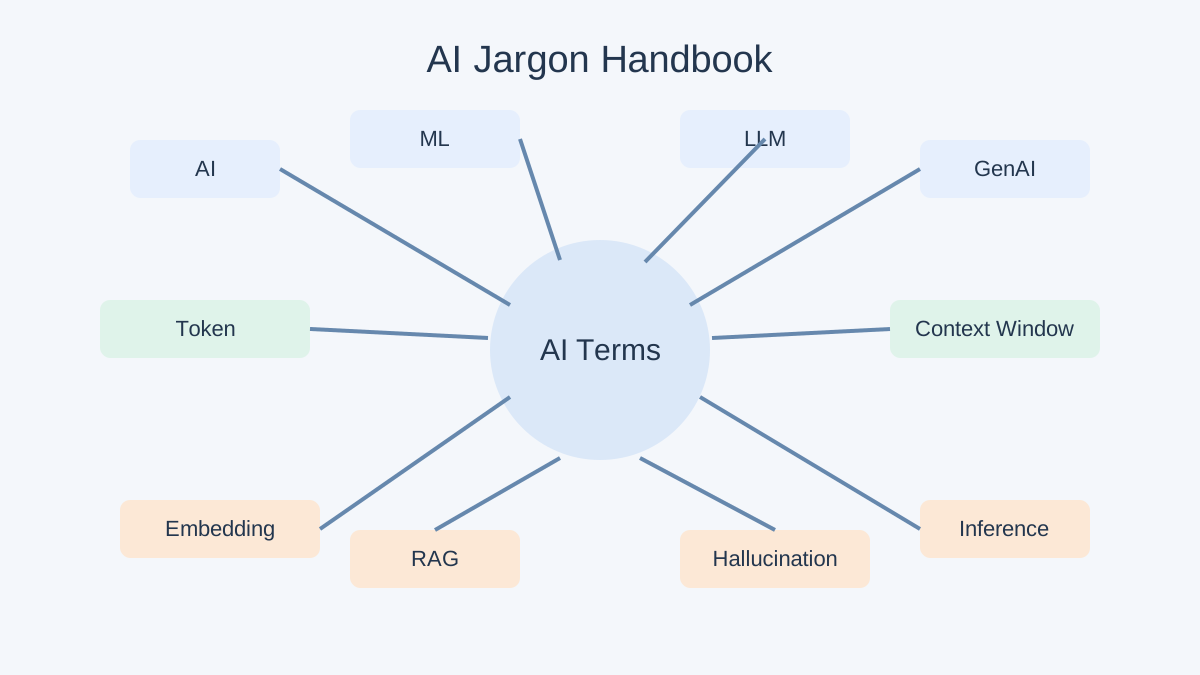
Overview
Before moving into Prompt Engineering, we need one consolidation step: a shared vocabulary. AI teams often talk in shorthand, and confusion about terms creates bad prompts, weak evaluations, and incorrect release decisions.
This lesson is your practical glossary. It is not just definition memorization. Each term is explained by meaning, usage, and QA relevance so you can apply it immediately in real test work.
A Practical Note for QA Learners
If this lesson feels more like vocabulary study than technical training, that is expected. The goal is not memorization for its own sake. The goal is to make sure that when your team says words like hallucination, context window, grounding, or RAG, everyone means the same thing.
For practical QA work, three things matter most:
- the right term often points to the right test
- unclear wording creates weak requirements and vague defect reports
- shared terminology reduces miscommunication across QA, product, and engineering
Learning Goals
- Understand the most common AI and LLM terms used in product teams.
- Distinguish similar terms that are often confused.
- Learn where each term appears in QA conversations and test plans.
- Build a shared terminology baseline for manual QA and SDET teams.
- Reduce ambiguity before starting Prompt Engineering techniques.
Core Concepts
1. The Essential AI Terminology Stack
| Term | Meaning | Typical usage |
|---|---|---|
| AI | Broad field for systems performing tasks that usually require human intelligence | Product strategy, automation roadmaps |
| ML | Subset of AI where models learn patterns from data | Classification, prediction, anomaly detection |
| Deep Learning | ML using many-layer neural networks | Vision, speech, LLM foundations |
| GenAI | AI that creates new content (text, code, image, audio) | Assistant features, content generation |
| LLM | Large language model trained to predict and generate text tokens | Chat assistants, summarization, coding support |
Quick rule:
- AI is the umbrella.
- ML and DL are methods.
- GenAI is a capability pattern.
- LLM is one specific model family in GenAI.
2. Input and Output Terminology
| Term | Meaning | QA implication |
|---|---|---|
| Prompt | Instruction/input to the model | Prompt quality controls output quality |
| Token | Small unit of text processed by model | Impacts cost, limits, truncation |
| Context Window | Max tokens model can consider at once | Long input tests are required |
| Output | Model-generated response | Must be validated, not trusted blindly |
| Inference | Runtime generation process | Performance and latency testing target |
Formula-level intuition:
3. Model Training and Adaptation Terms
| Term | Meaning | Usage |
|---|---|---|
| Pretraining | Large-scale general training on broad corpora | Base model creation |
| Fine-tuning | Additional training for domain/task behavior | Domain specialization |
| Instruction Tuning | Training to follow human-style instructions | Better assistant behavior |
| RLHF | Human-feedback loop for alignment | Helpfulness and safety shaping |
| Alignment | Techniques that make model behavior safer and more useful | Policy and risk control |
Why this matters for QA:
- You can diagnose whether a failure is likely from base model limits, fine-tuning gaps, or prompt design.
4. Retrieval and Knowledge Terms
| Term | Meaning | QA usage |
|---|---|---|
| Embedding | Vector representation of text/data | Semantic search and similarity matching |
| Vector DB | Storage optimized for vector similarity retrieval | RAG pipelines |
| RAG | Retrieval-Augmented Generation; model uses external fetched context | Reduces hallucination risk when retrieval is good |
| Grounding | Anchoring outputs to trusted provided sources | Citation and evidence checks |
Practical warning:
- RAG is not magic. Bad retrieval leads to bad grounded answers.
5. Output Quality and Risk Terms
| Term | Meaning | QA handling |
|---|---|---|
| Hallucination | Plausible but false output | Fact-check and evidence checks |
| Bias | Uneven behavior across groups/languages | Fairness and cohort testing |
| Robustness | Stability under paraphrase/noise/edge input | Mutation tests and regression |
| Deterministic vs Probabilistic | Exact repeatability vs stochastic variation | Use range- or rubric-based assertions |
| Guardrails | Policies and controls around generation | Safety test suites |
6. Agent Terminology (Preview Only)
You will learn this deeply later, but you should know the words now:
| Term | Meaning now | Note |
|---|---|---|
| Agent | AI workflow that can plan and act with tools | Full module later |
| Tool Calling | Model triggering external functions/APIs | Full module later |
| Memory | Stored context across tasks/turns | Full module later |
| Orchestration | Coordinating multiple model/tool steps | Full module later |
For this level, remember only this: an agent is not just a model answer; it is model plus execution workflow.
QA/SDET Relevance
Manual QA use:
- Use vocabulary consistently in test charters and defect reports.
- Separate model issues from integration issues in bug triage.
- Ask better clarifying questions when outputs look wrong.
QA automation and SDET use:
- Name test suites around clear concepts: context-limit tests, hallucination checks, RAG grounding checks.
- Build reusable evaluation templates with consistent terminology.
- Improve communication with engineering and AI platform teams.
Practical Work
Exercise: Build Your Team AI Terminology Cheat Sheet
Objective: Create one shared glossary used by QA, dev, and product.
Steps:
- Copy the 20 to 30 terms from this lesson.
- Add one project-specific example per term.
- Add one "what can go wrong" note per term.
- Review in sprint kickoff and update monthly.
Starter format:
| Term | Our product example | Risk if misunderstood |
|---|---|---|
| Context Window | Long customer ticket + logs exceeds model limit | Missing root cause detail |
| Hallucination | Model invents API field in response | Invalid test or implementation work |
| RAG | Support assistant pulls policy docs before answering | Wrong retrieval gives wrong answer |
Reflection:
- Which 5 terms cause most confusion in your team today?
- Which misunderstood term has the highest release risk?
- What vocabulary must be standardized before Prompt Engineering?
Key Takeaways
- Shared terminology is a quality control layer, not a formality.
- Many AI failures begin as language confusion in requirements or test plans.
- Terms like token, context window, inference, and grounding directly affect QA strategy.
- Agent-related terms are introduced now and will be covered deeply later.
- A team glossary reduces rework and improves cross-functional decisions.
Next Step
Continue with AI Terminology in Real QA Workflows to apply these terms in daily testing, automation, and release decisions.