AI Terminology Checkpoint Quiz
A quick self-check to confirm mastery of core AI terms before moving into Prompt Engineering.
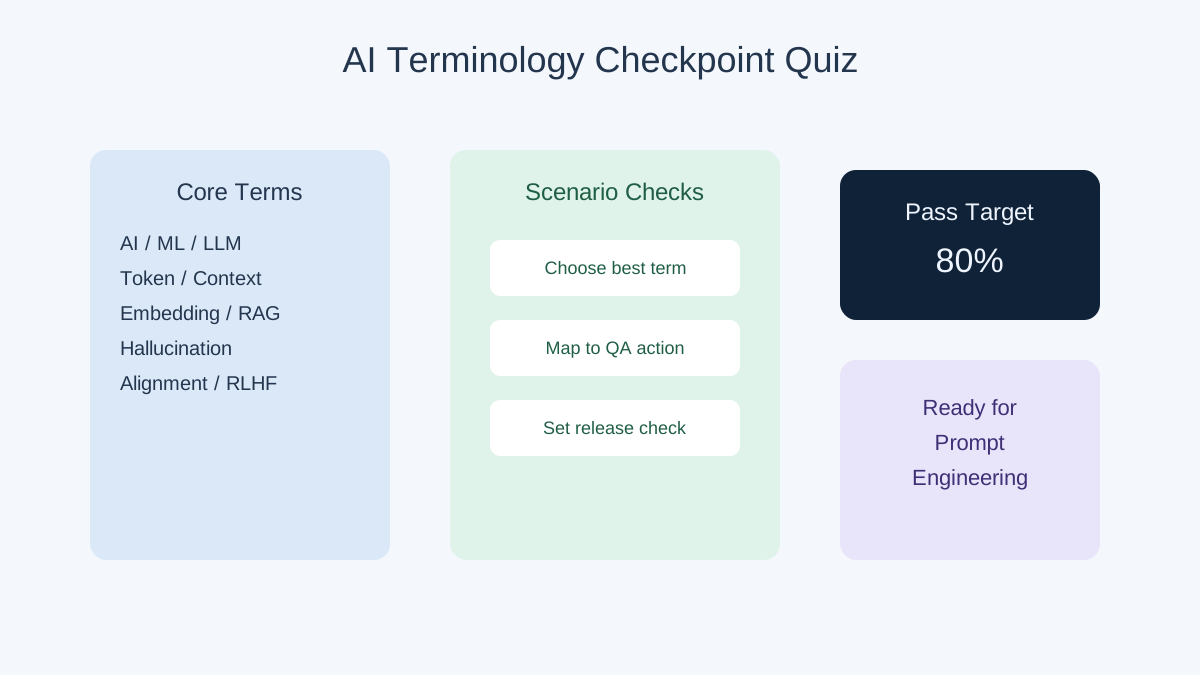
Overview
This checkpoint ensures your terminology understanding is operational, not superficial. If you can identify the right term, explain why it matters, and apply it to QA decisions, you are ready for Prompt Engineering.
Use this lesson as a self-assessment or team mini-review at sprint kickoff.
A Practical Note for QA Learners
Treat this as a readiness check, not as an exam. If you miss a few answers, that is useful feedback about which terms still need reinforcement before Prompt Engineering.
Recommended approach:
- answer all questions before scrolling to the answer key
- write down terms that felt uncertain
- revisit the earlier Level 4B lessons only for the weak spots
Learning Goals
- Validate your understanding of core AI and LLM vocabulary.
- Distinguish commonly confused terms under realistic scenarios.
- Practice translating terms into QA actions and release checks.
- Identify weak areas before Level 5 Prompt Engineering.
Quiz Format
- Section A: 10 quick concept checks.
- Section B: 5 scenario-based QA questions.
- Scoring guide at the end.
Suggested pass threshold:
- 80% or higher before moving to Prompt Engineering.
Try to complete Sections A and B before looking at the answer key below.
Checkpoint Snapshot
| Area | What to do |
|---|---|
| Before you start | Answer everything without scrolling to the answer key |
| While answering | Focus on the exact term that best describes the situation |
| After finishing | Review weak terms and revisit only those parts of Level 4B |
| Suggested pass mark | 80% or higher |
Section A: Core Concept Checks
1. What is the best definition of a token in LLM systems?
- A. A final answer generated by the model
- B. A small text unit processed by the model
- C. A model safety policy
- D. A vector database record
2. Context window refers to:
- A. Number of models in production
- B. Maximum tokens the model can consider at once
- C. Number of APIs an agent can call
- D. Number of output formats supported
3. Which term describes false but plausible model output?
- A. Grounding
- B. Hallucination
- C. Embedding
- D. Alignment
4. RAG mainly helps by:
- A. Increasing GPU memory
- B. Replacing the model architecture
- C. Injecting retrieved external context into generation
- D. Eliminating the need for validation
5. RLHF is primarily used to:
- A. Compress embeddings
- B. Tune model behavior using ranked human feedback
- C. Increase context window size
- D. Convert text into vectors
6. Which pair is most closely related to semantic search?
- A. Token + temperature
- B. Embedding + vector database
- C. Hallucination + guardrail
- D. Prompt + stop token
7. If output varies across runs for the same prompt, the best explanation is:
- A. Deterministic bug only
- B. Probabilistic generation behavior
- C. Missing API key
- D. Corrupted vector index
8. Which term best matches "anchor response to source evidence"?
- A. Grounding
- B. Fine-tuning
- C. Top-k
- D. Agent memory
9. A model that follows conversation roles and instructions better is usually:
- A. A base model only
- B. A chat or instruction-tuned model
- C. A smaller embedding model
- D. A vector index model
10. "Agents" in this course should currently be treated as:
- A. Already mastered topic
- B. Unimportant topic
- C. Preview term; deep coverage comes later
- D. Only relevant for managers
Section B: Scenario-Based QA Questions
11. Long Prompt Failure
Your assistant missed a critical acceptance rule in a long prompt with logs.
What are the two most relevant terms to investigate first?
12. Invented Schema Field
The model produced a confident API field that does not exist in your schema.
Name the primary failure type and one validation control.
13. Paraphrase Instability
Two prompts with same intent but different wording produce very different output quality.
Which quality dimension is most impacted, and what test style should you add?
14. Vague Product Requirement
Product says "AI should be smart and accurate."
Rewrite this using at least two precise AI terms and one measurable QA check.
15. Memory Without Governance
Team proposes "add agent memory now" without retention policy discussions.
What terminology-based risk should QA raise before implementation?
Answer Key
Section A Answers
| Question | Correct answer |
|---|---|
| 1 | B |
| 2 | B |
| 3 | B |
| 4 | C |
| 5 | B |
| 6 | B |
| 7 | B |
| 8 | A |
| 9 | B |
| 10 | C |
Section B Guidance
| Question | Strong answer should include |
|---|---|
| 11 | Context window and token budget, plus prompt structure quality |
| 12 | Hallucination, plus schema validation and grounding checks |
| 13 | Robustness or stability, plus prompt paraphrase mutation tests |
| 14 | Example: "Grounded summary must use only provided ticket evidence; hallucination rate below agreed threshold on gold set." |
| 15 | Memory, privacy, governance, retention, consent, and data leakage concerns |
Scoring Guide
| Score | Meaning |
|---|---|
| 13 to 15 correct | Ready for Level 5 Prompt Engineering |
| 10 to 12 correct | Review weak terms, then proceed |
| Below 10 | Revisit Level 4B lessons before continuing |
Practical Work
Run this as a team exercise:
- Take the quiz individually.
- Compare answers in pairs.
- Standardize term definitions in your QA playbook.
- Add at least 5 term-driven checks to your AI regression suite.
Key Takeaways
- Terminology mastery improves test quality and team communication.
- The right word often points to the right test.
- You are ready to begin Prompt Engineering when term usage is precise and actionable.
Next Step
Proceed to Level 5, Prompt Engineering Fundamentals. If that lesson is not fully available yet, use your quiz results to identify which terms still need practice before continuing.