AI Fundamentals
Understand AI, ML, deep learning, generative AI, and the broader AI ecosystem.

Overview
This lesson turns the broad AI discussion into the core concepts every QA professional should know.
If the first lesson explained *why* AI matters, this one explains *what* AI actually is, how the main categories differ, and why the terminology matters when you are evaluating tools or writing prompts.
Once you understand the layers of AI, the product decisions around AI tools become much easier to evaluate.
Learning Goals
By the end of this lesson, you should be able to:
- Define AI in practical terms.
- Explain the difference between AI, machine learning, deep learning, and generative AI.
- Distinguish narrow AI from general AI.
- Understand why AI systems behave differently from traditional software.
- Recognize common real-world AI examples used by QA teams and consumers.
1. What Is AI?
Artificial Intelligence is a broad term for systems that perform tasks associated with human intelligence.
In practice, that can include:
- pattern recognition
- prediction
- classification
- text generation
- image analysis
- speech recognition
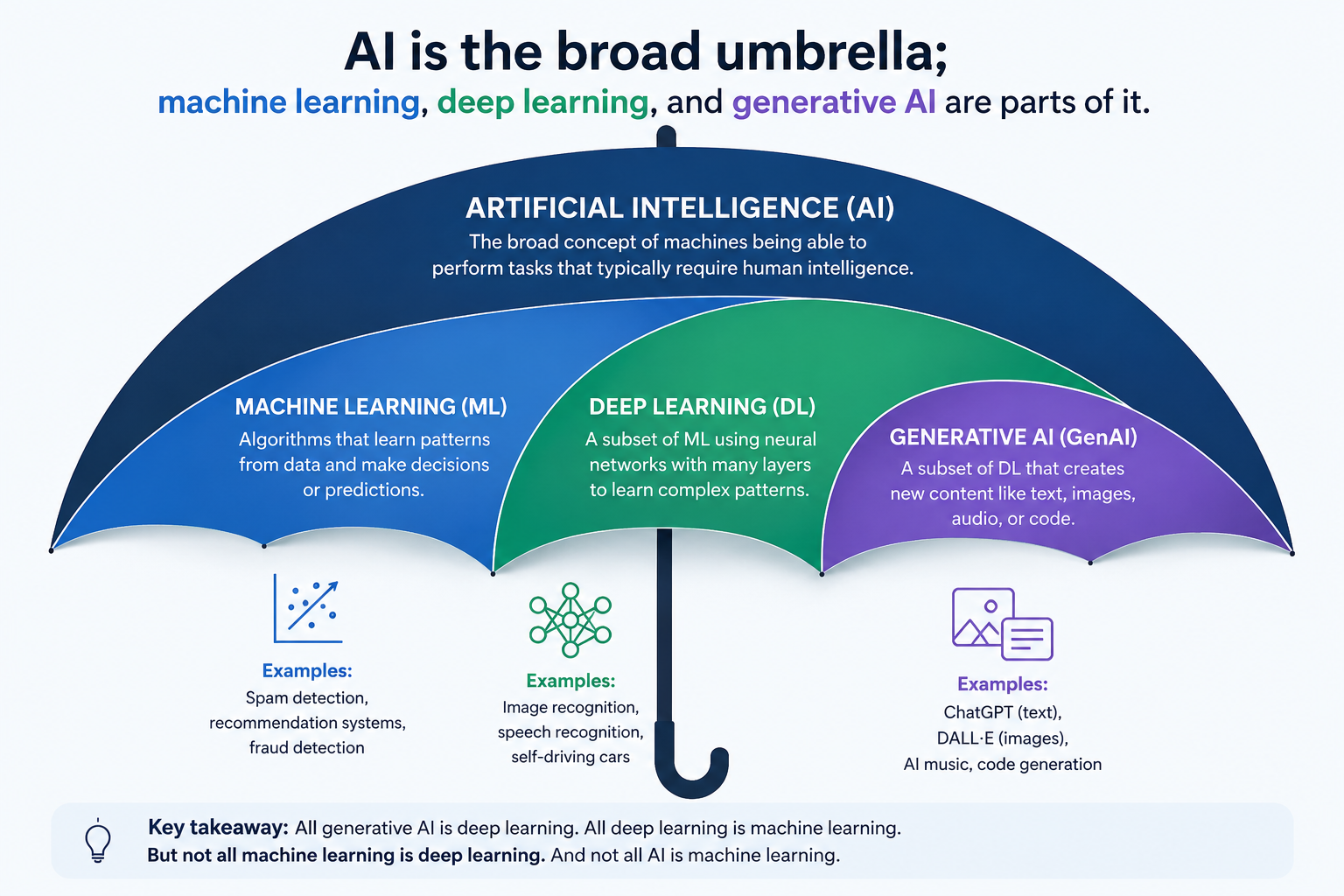
AI is an umbrella term. It includes many techniques, not just chatbots.
2. The AI Learning Stack
Think of AI as a stack of related ideas.
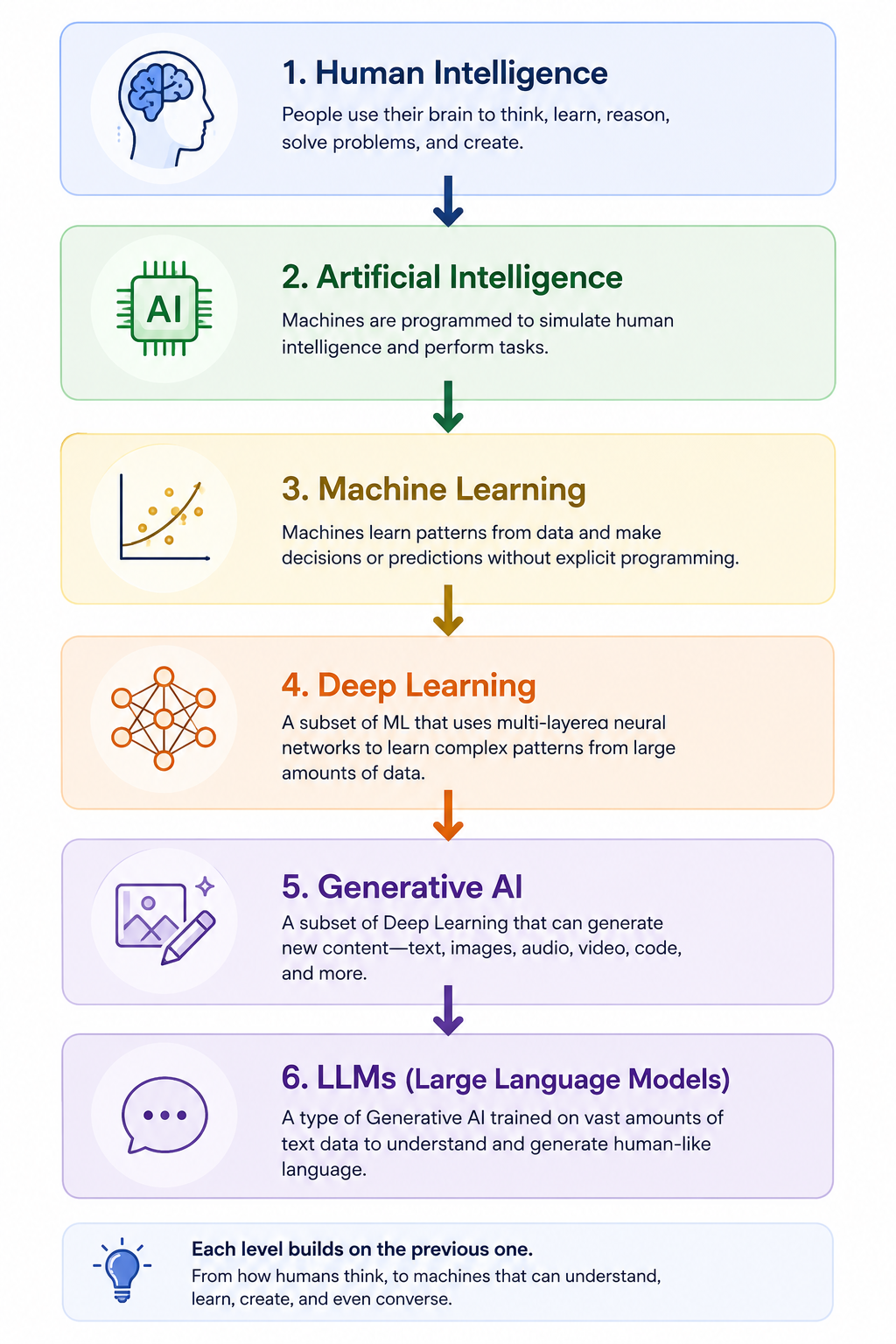
Each layer narrows the focus and makes the concept more practical.
| Layer | What it means |
|---|---|
| AI | The broad field of intelligent systems |
| Machine Learning | Systems that learn patterns from data |
| Deep Learning | Neural networks with multiple layers |
| Generative AI | Models that create new text, images, code, or video |
| LLMs | Large language models that specialize in text and language tasks |
3. AI vs Machine Learning
People often use these terms interchangeably, but they are not the same.
- AI is the larger field.
- Machine learning is a subset of AI.
- Deep learning is a subset of machine learning.
- Generative AI is a modern application area built on top of these ideas.
For QA professionals, this distinction matters because it helps you ask better questions:
- Is this tool rule based or learned from data?
- Does it predict, classify, or generate?
- Is the model deterministic or probabilistic?
4. Narrow AI vs General AI
Most AI tools you use today are narrow AI.
They are good at specific tasks:
- recommending content
- detecting fraud
- summarizing text
- generating test cases
General AI would mean a system that can perform any intellectual task a human can do.
That does not exist in the practical product sense today.
5. Predictive AI vs Generative AI
This is one of the most useful distinctions for QA work.
| Type | What it does | Example |
|---|---|---|
| Predictive AI | Estimates a label or value | Spam detection, fraud scoring |
| Generative AI | Creates new content | ChatGPT, image generation, code generation |
Predictive AI answers questions like:
- Is this transaction suspicious?
- Will this customer churn?
Generative AI answers questions like:
- Write 20 test cases for this feature.
- Summarize this defect in plain English.
- Draft a SQL query for this dataset.
6. Real-World Examples
AI is already visible in everyday products:
- Netflix recommendations
- Amazon product suggestions
- Fraud detection systems
- Face recognition
- Speech-to-text
- ChatGPT
- GitHub Copilot
These examples show that AI is not just a research topic. It is already embedded in the software stack.
7. Why the Ecosystem Matters
When you work with AI tools, you are usually working with an ecosystem, not a single model.
That ecosystem may include:
- the model
- the prompt
- the context window
- embeddings
- retrieval
- safety filters
- UI or workflow design
That is why AI results can vary so much. A good model with a poor prompt can still produce a weak answer.
8. Practical Work
Mini Lab: Build Your AI Concept Map
Spend 30 to 40 minutes on this exercise:
- Create a simple concept map with these nodes:
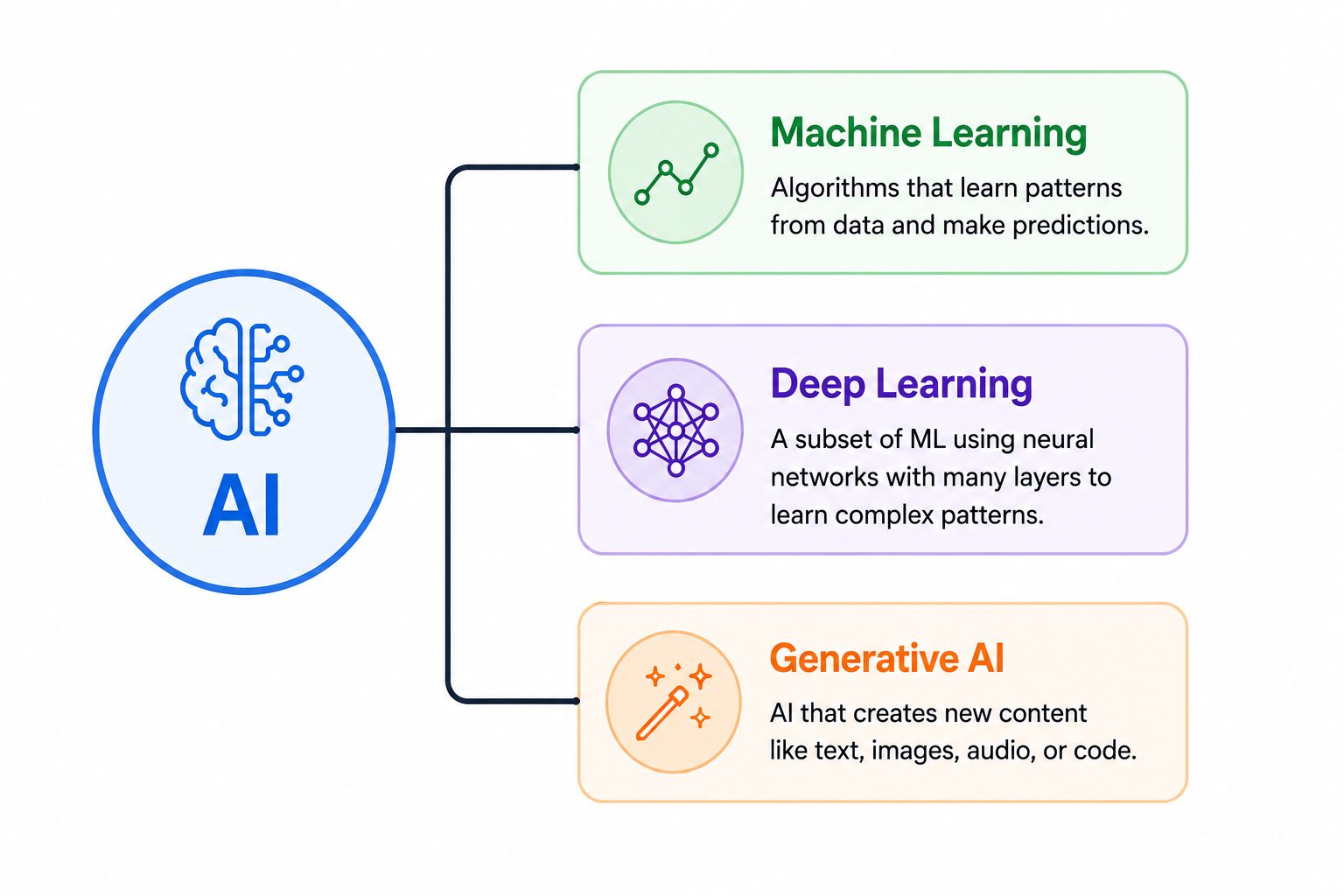
- Add two examples under each node.
- Mark which examples are predictive and which are generative.
- Identify at least two AI tools you use or know in QA work.
- Write a short note for each tool explaining whether it is more useful for prediction, generation, analysis, or automation.
QA Scenario Exercise
Take one feature from a real project and answer:
- Could AI help design test cases here?
- Could AI help summarize requirements?
- Could AI help create test data?
- Would you trust AI to make the final decision without review?
Expected Outcome
By the end of the exercise, you should have:
- a simple AI concept map
- a short list of AI examples in your daily life
- a short list of QA use cases where AI helps
- a short list of places where human review is still required
9. Key Takeaways
- AI is the broad umbrella; machine learning, deep learning, and generative AI are parts of it.
- Most production AI today is narrow AI.
- Predictive AI and generative AI solve different kinds of problems.
- QA professionals should understand the ecosystem, not just the model name.
- AI is most useful when you know what kind of output you expect.
Next Step
The next lesson will simplify machine learning further and show how classification, regression, clustering, and reinforcement learning fit into the picture without requiring math-heavy background.