Why Everyone Is Talking About AI
History of AI, AI winters, the rise of generative AI, and how AI is changing QA roles.
Overview
Artificial Intelligence is no longer something that sits far away in research labs. It is already shaping the tools QA teams use every day, from search to test generation to defect analysis.
For QA professionals, the goal is not to become machine learning researchers. The goal is to understand enough of the landscape to make good decisions, ask the right questions, and spot where AI helps or hurts quality.
AI is becoming a baseline skill for QA teams, the same way test automation once became a baseline skill.
Learning Goals
By the end of this lesson, you should be able to:
- Explain why AI became mainstream only recently.
- Describe the major milestones in AI history.
- Understand the AI winter and why progress slowed.
- Explain why generative AI changed the conversation.
- Connect AI adoption to real QA work.
- Separate practical AI use cases from inflated marketing claims.
1. Introduction
Artificial Intelligence is already part of daily life:
- Netflix recommendations
- YouTube suggestions
- Google Maps routing
- Face recognition
- Voice assistants
- Fraud detection
- ChatGPT
- GitHub Copilot
That same shift is now reshaping software testing and quality engineering. QA teams are using AI to draft test cases, summarize failures, analyze requirements, and speed up repetitive work.
2. Why Is Everyone Suddenly Talking About AI?
AI did not appear overnight. The current wave is the result of three things arriving at the same time.
| Driver | Why it mattered |
|---|---|
| Massive data | The internet created books, articles, code, videos, and conversations at huge scale. |
| Powerful computing | Modern GPUs and cloud systems made training much faster and cheaper. |
| Better algorithms | Neural networks, deep learning, transformers, and reinforcement learning improved results dramatically. |
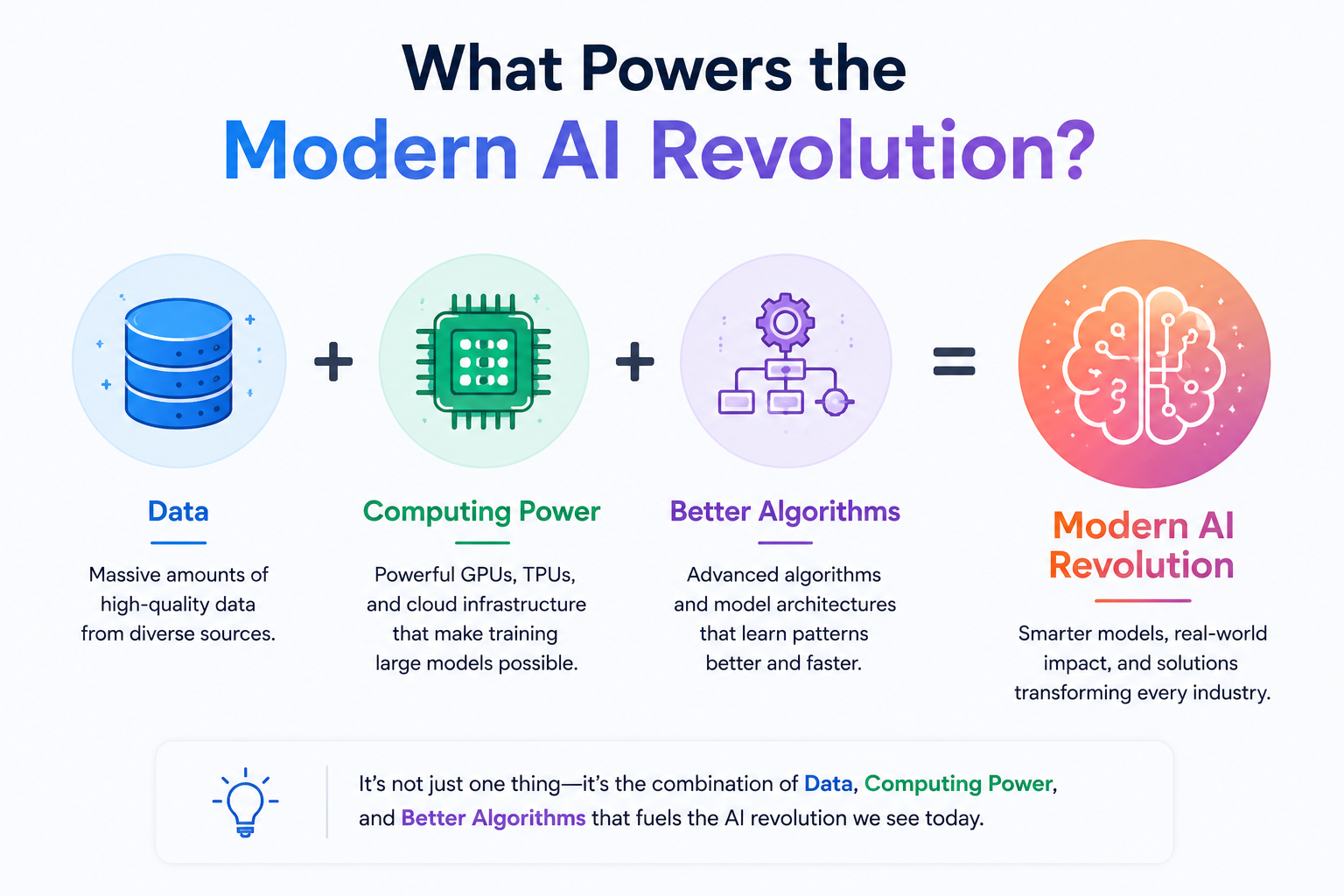
That combination is why AI feels suddenly everywhere, even though the field has existed for decades.
3. Brief History of AI
1950 - The Beginning
Alan Turing asked a simple but powerful question: can a machine behave intelligently enough that a human cannot tell the difference?
That question became one of the earliest anchors for the entire field.
1956 - Birth of AI
At the Dartmouth Conference, John McCarthy coined the term Artificial Intelligence. Researchers believed intelligent machines were just around the corner.
That prediction turned out to be far too optimistic.
1960s to 1970s - Early AI Systems
Early systems were mostly rule based:
- if X, then Y
- expert systems
- knowledge systems
- narrow decision tools
They worked for bounded use cases, but they did not learn from data in the way modern systems do.
1980s - Expert System Boom
Companies invested heavily in AI for:
- medical diagnosis
- financial systems
- manufacturing workflows
The interest was real, but the limits became visible quickly.
1980s to 1990s - AI Winter
Expectations were too high and results did not keep up.
Funding dropped. Progress slowed. The field entered what became known as the AI Winter.
2000s - Machine Learning Era
Instead of hard coding rules, systems started learning patterns from data.
Common examples included:
- spam filtering
- recommendations
- fraud detection
2010s - Deep Learning Breakthrough
Deep neural networks unlocked major gains in:
- image recognition
- speech recognition
- language translation
This was the moment AI started to feel much more practical at scale.
2020s - Generative AI Revolution
Generative AI made AI accessible to everyone.
Examples:
- ChatGPT
- Claude
- Gemini
This is the shift that brought AI into every product discussion, including QA.
4. Why QA Professionals Should Care
AI is changing QA in two ways.
First, it is changing the tools.
Second, it is changing the expectations around speed, scale, and quality.
| QA Area | AI Impact |
|---|---|
| Test design | Faster draft test cases from requirements |
| Test data | Synthetic and scenario-based data generation |
| Defect analysis | Better summaries and root-cause support |
| Automation | Faster code scaffolding and refactoring help |
| Reporting | Cleaner summaries for stakeholders |
5. First ChatGPT Interaction
If this is your first AI experience, start with something simple and compare it to how you would normally search.
Try this prompt:
1Explain the difference between AI and traditional software in a way a QA analyst can understand.2Use one practical testing example.Then compare the result with a normal Google search.
You will usually notice:
- Search is good for finding sources.
- ChatGPT is good for synthesizing an answer.
- AI is most useful when you need a first draft, explanation, or structured idea.
6. AI vs Traditional Software
Traditional software follows explicit rules written by humans.
AI systems behave differently:
- they learn from data
- they can generalize
- they may produce probabilistic outputs
- they can be wrong with confidence
That last point matters a lot for QA. An AI tool can sound convincing while still being incorrect, incomplete, or biased.
QA for AI is not just about checking functionality. It is also about checking confidence, consistency, and safety.
7. Common AI Myths
| Myth | Reality |
|---|---|
| AI understands everything like a human | AI predicts outputs from patterns; it does not reason like a person. |
| AI will replace all testers soon | AI changes QA work, but human judgment is still essential. |
| More tokens always means better answers | Better structure and context often matter more than length. |
| AI is always accurate | AI can hallucinate and confidently produce wrong output. |
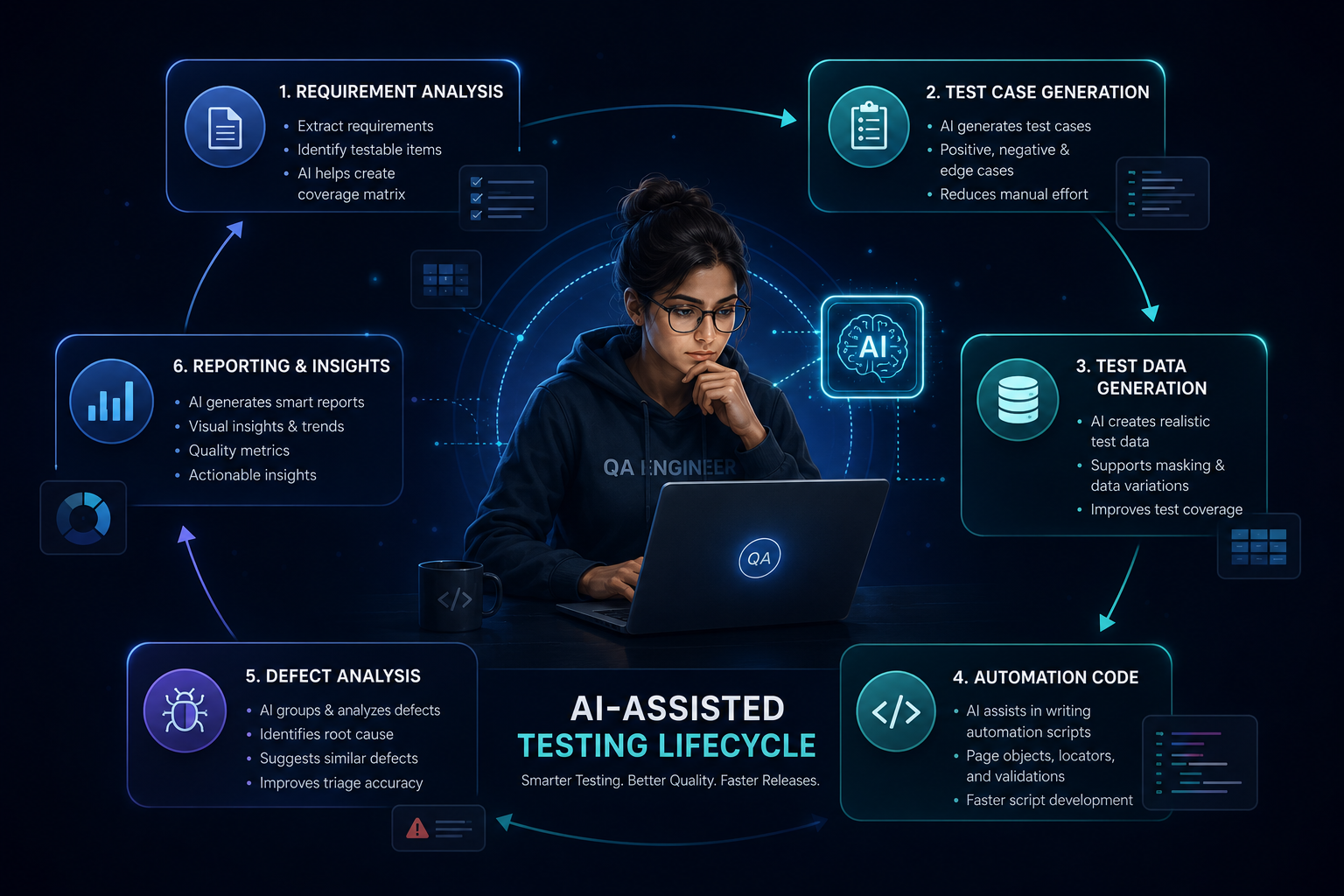
8. How AI Is Changing QA
AI is not replacing QA. It is changing the shape of QA work.
The teams that benefit most are the ones that use AI to reduce repetitive effort, increase coverage, and improve the quality of early thinking while still keeping human review in the loop.
Requirement Analysis
AI can help QA teams by:
- summarizing long requirements
- extracting business rules
- identifying missing edge cases
- turning user stories into testable questions
- highlighting ambiguous wording
This is especially useful when requirements are large, distributed across multiple documents, or written in a way that is difficult to scan quickly.
Test Case Generation
AI is strong at producing a first draft of test coverage.
It can suggest:
- positive scenarios
- negative scenarios
- boundary tests
- role-based checks
- regression candidates
- exploratory test ideas
The key is that AI should draft the test matrix, while QA decides what is actually relevant, risky, and worth executing.
Test Data Generation
AI can speed up the creation of realistic but safe test data:
- names
- emails
- addresses
- phone numbers
- product-like records
- synthetic edge cases
For QA teams working on forms, workflows, and API validation, this is one of the fastest ways to reduce manual setup time.
Automation Development
AI can help with the first draft of automation assets:
- Selenium scripts
- Playwright tests
- Cypress tests
- API test scaffolds
- page object structure
- assertion suggestions
That said, generated code still needs review. In UI automation, resilient locators, clear assertions, and stable test flow matter more than just generating code that compiles. A good AI-assisted automation workflow should still follow the same quality rules as hand-written automation.
Defect Analysis
AI can help QA teams analyze failure information faster:
- summarize logs
- group duplicates
- suggest likely root causes
- compare similar failures
- reduce noisy triage work
This is valuable when a team has many failing tests or a large volume of bug reports.
Documentation
AI can also reduce the cost of writing and updating supporting material:
- test summaries
- release notes
- execution reports
- defect summaries
- status updates for stakeholders
This is one of the easiest ways to create immediate productivity gains for QA teams.
What AI Should Not Own Alone
AI is useful, but it should not be the final authority in the places that matter most.
Keep human review for:
- final test strategy decisions
- release go/no-go decisions
- high-risk defect triage
- compliance-sensitive validation
- security-sensitive workflows
- anything that could impact real users without review
AI can accelerate QA, but it cannot replace the judgment, context, and accountability that a QA professional brings.
QA Automation Mindset
The best automation teams will use AI like a copilot, not an autopilot.
That means:
- use AI to draft code
- use QA to validate design
- use automation patterns that are maintainable
- prefer stable, user-facing locators
- review generated code before it enters the test suite
Why This Matters
AI helps QA most when it removes low-value work and gives you more time for the work that actually needs expertise:
- deciding what should be tested
- understanding product risk
- reviewing automation quality
- investigating failures
- protecting users from bad releases
9. Lesson Preview
In the next lesson, we will break AI into its core building blocks and turn the hype into practical concepts you can actually use in QA work.
You will move from:
- broad AI awareness
- to AI fundamentals
- to real-world examples and workflows
Key Takeaways
- AI became mainstream because data, compute, and algorithms improved together.
- The field has a long history, including a long AI winter.
- Generative AI is the reason AI feels usable in daily work now.
- QA teams should understand AI well enough to review, test, and use it responsibly.
- AI is useful, but it is not automatically correct.
Next Step
In the next lesson, we will simplify AI into the core building blocks QA professionals need to understand before going deeper into machine learning and generative AI.