Machine Learning Simplified
A conceptual, non-mathematical introduction to supervised, unsupervised, and reinforcement learning for QA professionals.
Overview
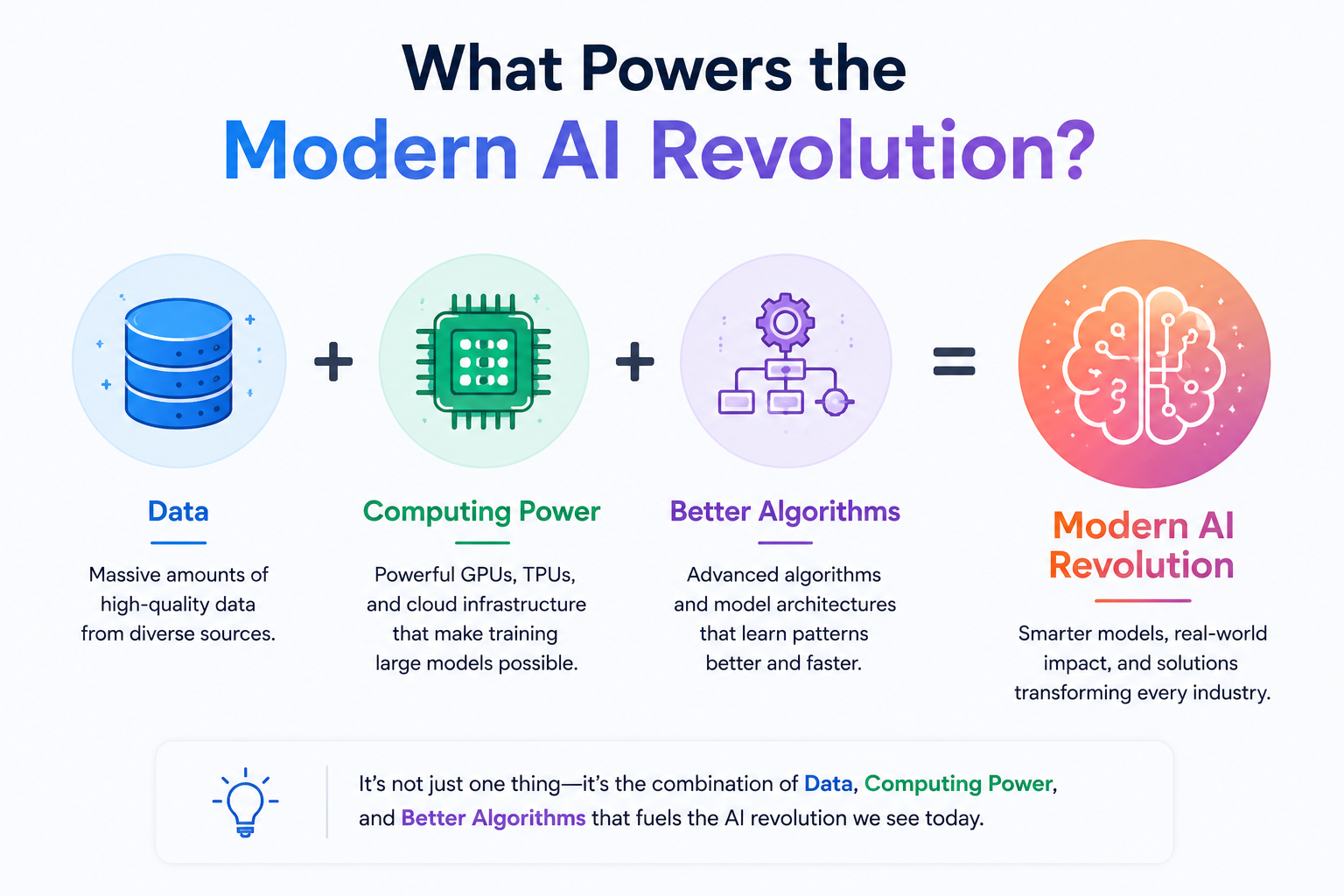
Machine learning is the part of AI that learns patterns from data instead of relying only on hand-written rules.
For QA professionals, the useful mindset is simple: machine learning is about making a system better at a task after it has seen examples. That task may be classification, prediction, grouping, ranking, or decision support.
Machine learning is not magic. It is pattern learning powered by data, feedback, and evaluation.
Learning Goals
By the end of this lesson, you should be able to:
- Explain machine learning in plain language.
- Distinguish supervised, unsupervised, and reinforcement learning.
- Understand classification, regression, and clustering at a beginner level.
- Recognize why training data quality matters so much.
- Spot overfitting in simple terms.
- Connect machine learning ideas to QA workflows and automation work.
1. What Is Machine Learning?
Machine learning is a subset of AI that uses data and algorithms to learn patterns and make predictions or decisions.
The common idea is:
- show the system examples
- let it learn patterns
- test it on new cases
- improve it if it performs poorly
This is why ML is so strongly tied to data quality, labels, and evaluation.
2. The Three Big ML Styles
Most beginner-level ML conversations can be grouped into three styles. This visual is a simple way to remember the overall flow from raw data to a decision or prediction.
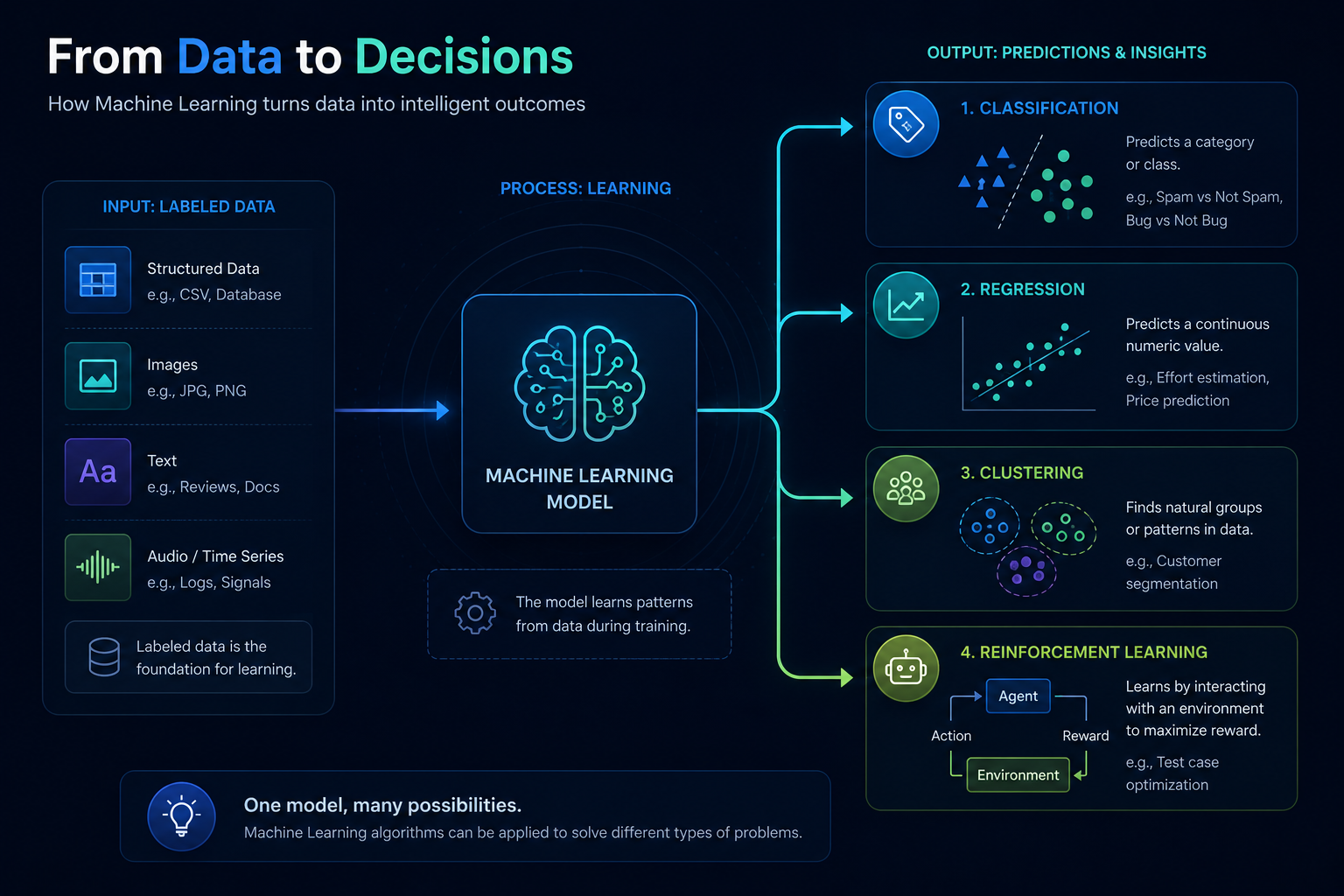
At a high level, the picture is saying: data enters the system, the model learns patterns, and the output becomes useful for a specific task.
| Style | What it learns from | What it usually does |
|---|---|---|
| Supervised learning | Labeled examples | Predicts a known answer |
| Unsupervised learning | Unlabeled data | Finds hidden structure |
| Reinforcement learning | Rewards and feedback | Learns actions through trial and error |
For QA professionals, this breakdown matters because each style solves a different kind of problem. Supervised learning is often the best fit when you already know the labels you want, unsupervised learning helps when you want to discover patterns, and reinforcement learning is better suited to systems that improve by trial and feedback.
3. Supervised Learning
Supervised learning is the most common starting point in classical ML.
It learns from examples where the correct answer is already known.
In NIST terms, supervised learning predicts explicit labels or output values from examples. Google and scikit-learn also frame it as learning from labeled data to make predictions on new data. AWS groups common supervised tasks into classification and regression.
Classification
Classification means predicting a category.
QA-friendly examples:
- pass or fail
- spam or not spam
- defect or not defect
- high, medium, or low risk
- duplicate or unique defect
If a model learns from examples of already-labeled defects, it can later help classify a new defect report into a likely severity bucket or issue type.
Regression
Regression means predicting a number instead of a category.
QA-friendly examples:
- estimated test execution time
- predicted number of failures
- expected defect count for a release
- approximate traffic volume
This is useful when you want a numerical estimate rather than a label.
Simple Supervised Example
Imagine a team that has 500 historical bug reports.
Each one is labeled with:
- component
- severity
- defect type
- resolution status
A supervised model can learn from those examples and help predict the most likely severity of a new bug report.
That does not replace triage. It simply gives QA a useful starting point.
4. Unsupervised Learning
Unsupervised learning works with unlabeled data.
Instead of asking, "What is the correct answer?", the model asks, "What patterns are here?"
That makes it useful for discovering structure in data.
Clustering
Clustering groups similar items together.
QA examples:
- group similar defect reports
- cluster flaky test failures by signature
- group test cases by feature area
- segment customer feedback into themes
If you have a pile of untagged issues, clustering can reveal that several tickets are actually part of the same root problem.
Practical QA Use Case
Suppose a release creates 200 test failures.
An unsupervised model can help group them by:
- error message
- stack trace similarity
- failing page
- environment
That makes triage faster and reduces duplicate investigation.
5. Reinforcement Learning
Reinforcement learning is a different style of ML.
An agent takes actions in an environment and learns from rewards or penalties over time.
IBM and AWS describe this as trial-and-error learning for autonomous agents making sequential decisions.
For a beginner QA audience, the simplest way to think about RL is:
- the system tries an action
- it gets feedback
- it adjusts the next action
- it repeats until it improves
Where It Shows Up
Reinforcement learning is less common in everyday QA workflows than supervised learning, but it matters in:
- robotics
- simulation
- autonomous decision systems
- optimization problems
- some advanced AI training pipelines
You do not need to become an RL expert to understand the broader AI landscape. You just need to know that it is another way machines can improve from feedback.
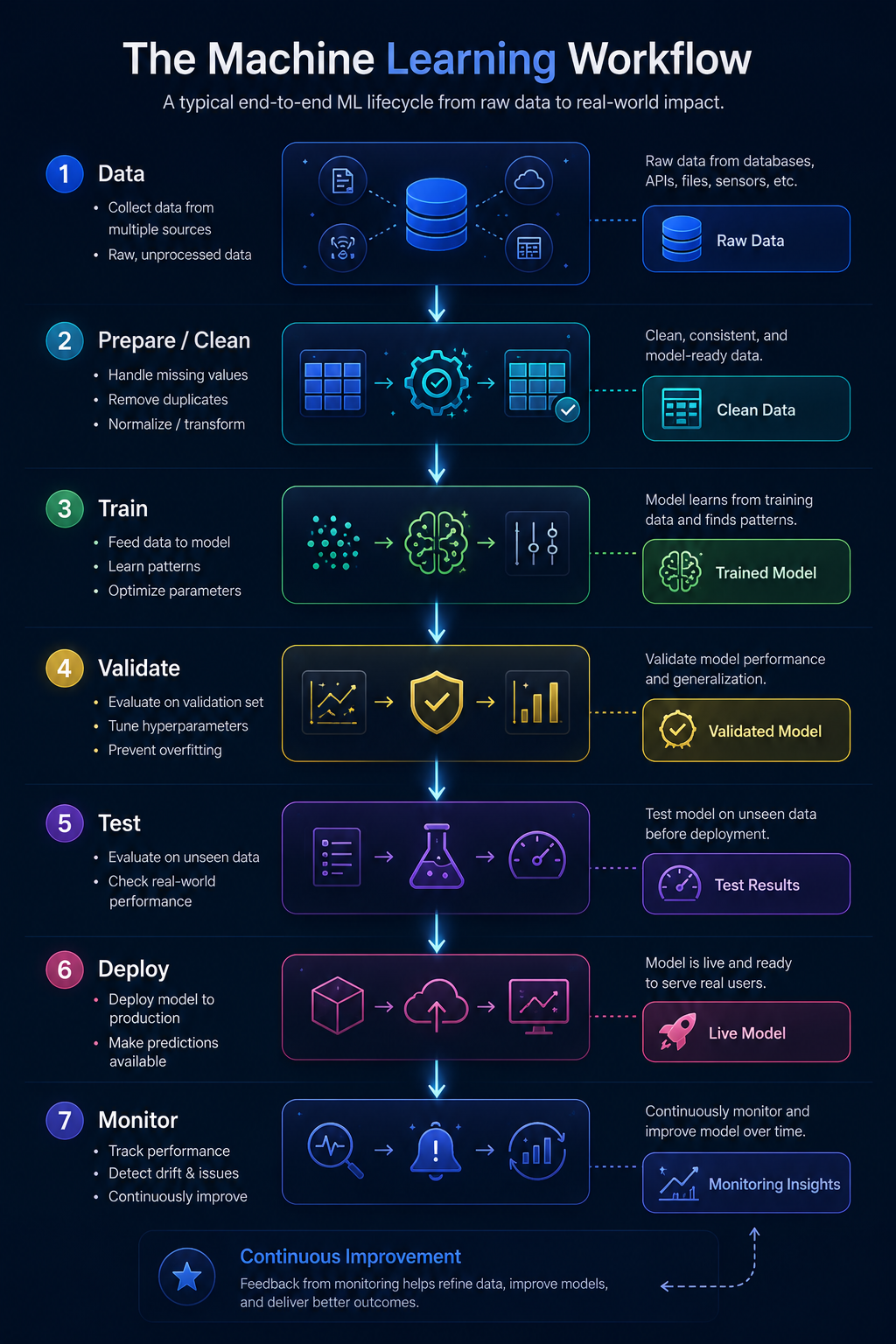
6. The Machine Learning Workflow
Even when the model type changes, the workflow is usually similar.
Why This Matters
The model is only one part of the system.
If the data is poor, the labels are inconsistent, or the evaluation is weak, the output will be weak too.
That is why Google’s ML Crash Course emphasizes data quality, training/validation/test splits, and generalization.
7. Overfitting in Simple Terms
Overfitting happens when a model does great on training data but performs poorly on new data.
Think of it like memorizing practice questions instead of learning the actual concept.
Google’s ML Crash Course describes overfitting as a common problem where a model fits the training set too closely and fails to generalize.
For QA teams, the lesson is important:
- do not trust training performance alone
- always test on unseen data
- watch for fragile patterns
- prefer models that generalize well
Simple Analogy
If a test engineer memorizes one test script by heart but does not understand the product behavior, they may look good in rehearsal and fail in a real release.
ML can fail the same way.
8. Why ML Matters for QA
Machine learning helps QA in practical ways because QA teams work with patterns all the time.
Requirement Analysis
ML can help identify recurring terms, themes, or risk areas in large volumes of requirements or feedback.
Defect Triage
ML can help classify bug reports, cluster duplicates, or suggest likely ownership areas.
Test Prioritization
ML can support prioritization by finding risky areas or spotting changes that are more likely to fail.
Test Data and Simulation
ML can help produce synthetic examples or identify unusual edge cases.
Automation Assistance
ML is not the same as test automation, but it can support automation by helping recognize patterns, stabilize workflows, or assist with smarter predictions.
9. Machine Learning vs Rule-Based Logic
Traditional software says:
1if condition A, do BMachine learning says:
1learn from examples, then estimate the best answer for new dataThat is why ML can be powerful in areas where rigid rules get messy.
Examples:
- fraud detection
- recommendation systems
- spam filtering
- defect classification
- quality scoring
10. Common Beginner Mistakes
| Mistake | Why it causes problems |
|---|---|
| Using bad data | The model learns the wrong patterns |
| Confusing training success with real-world success | A model can memorize instead of generalizing |
| Expecting AI to be perfect | ML systems are probabilistic, not magical |
| Skipping evaluation | You cannot trust what you do not test |
| Using the wrong ML style | Classification, regression, clustering, and RL solve different problems |
11. Practical Work
Mini Lab: Classify Three QA Problems
Take these three situations and decide which ML style fits best:
- Group 100 bug reports into common themes.
- Predict whether a release is high-risk or low-risk.
- Estimate how many test failures a build may produce.
Then answer:
- Which one is classification?
- Which one is regression?
- Which one is clustering?
Hands-On Reflection
Write short answers to these questions:
- What kind of data would you need for each task?
- Would you need labels?
- Would you expect exact answers or approximate answers?
- Would human review still be required?
QA Scenario
Imagine your team receives many defect reports after every sprint.
Design a simple approach where ML could help:
- How would you label or group the defects?
- What would you train on?
- What would you evaluate?
- How would QA still stay in control?
Key Takeaways
- Machine learning learns patterns from data rather than relying only on fixed rules.
- Supervised learning uses labels, unsupervised learning finds structure, and reinforcement learning learns from rewards.
- Classification predicts categories and regression predicts numbers.
- Overfitting is a common risk when a model memorizes training data instead of generalizing.
- QA teams can use ML for triage, prioritization, analysis, and pattern discovery.
- ML supports QA judgment; it does not replace it.
Next Step
Next, we will examine how tools like ChatGPT and Claude work at a high level. That context will make the neural-network lessons more intuitive when we move into deep learning.