AI for API Testing and Data Validation
Use AI to generate API matrices, payloads, contract checks, and SQL validation strategies.
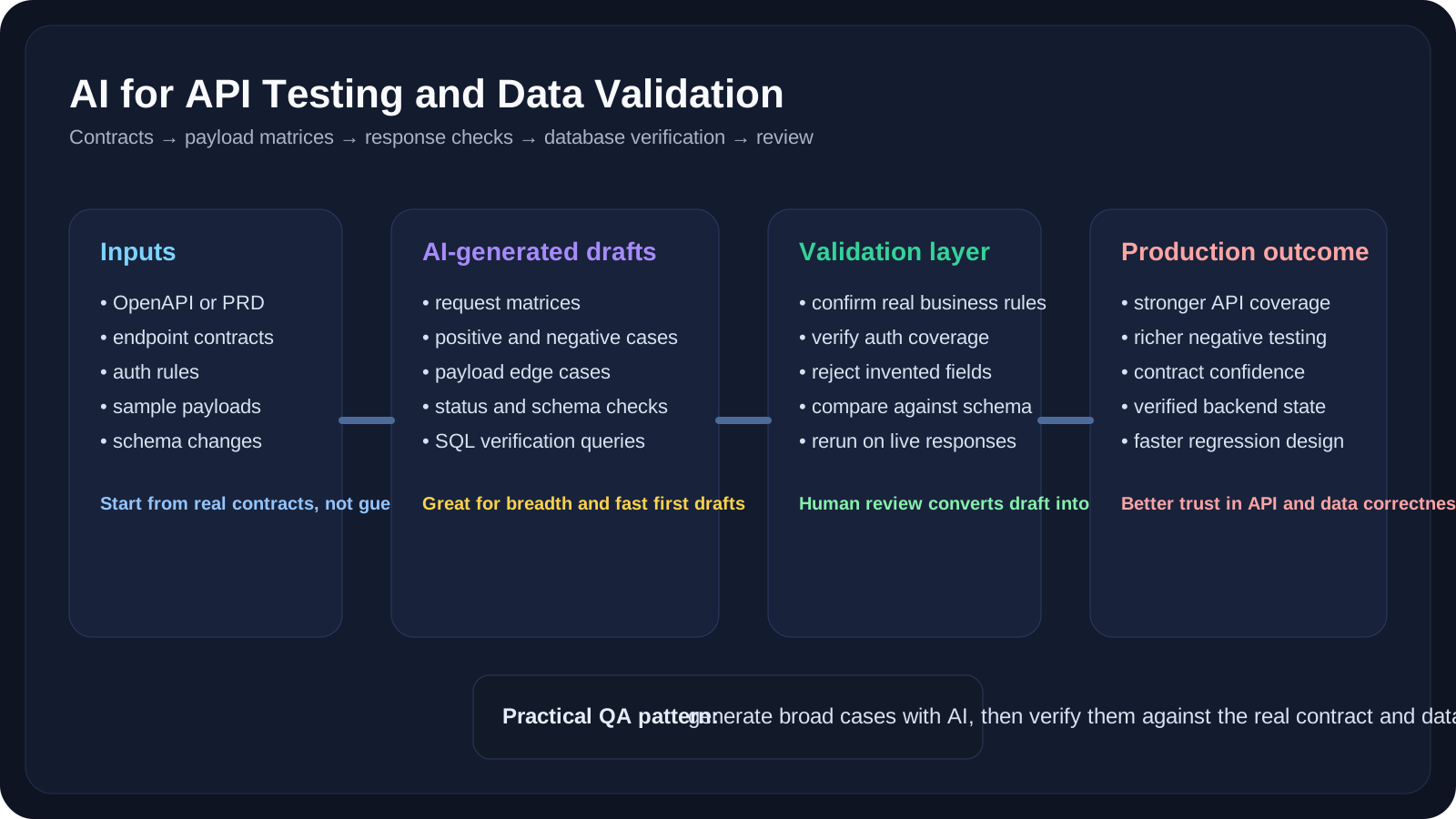
Overview
This companion lesson follows the Playwright lesson and shifts the focus from visible UI behavior to backend contracts and data correctness.
API testing and data validation are high-return areas for AI-assisted automation because the structure is explicit and testable. AI can help generate request matrices, error-path coverage, contract checks, and SQL validation ideas much faster than manual drafting alone.
The key mindset stays the same as the UI lesson:
- AI helps create breadth faster
- engineers still verify meaning and correctness
- real contracts matter more than fluent-looking output
A Practical Note for QA and API Testers
This lesson is especially useful if your current work includes:
- REST or GraphQL validation
- backend workflow verification
- auth and permission testing
- SQL checks after business transactions
Learning Goals
- Generate better API coverage with AI
- Create richer payload and error-path sets
- Use AI to draft SQL and backend validation checks
- Review AI output critically against real contracts and business rules
10 Practical Examples
Example 1: CRUD matrix generation
Ask AI for positive and negative cases across POST, GET, PUT, and DELETE flows.
Example 2: Auth coverage
Generate:
- missing token
- expired token
- wrong scope
- wrong role
- wrong tenant
Example 3: Payload edge cases
Ask for:
- nulls
- unicode
- max length
- malformed enums
- injection-like inputs
Example 4: Status expectation draft
Ask AI to map request conditions to likely 200, 400, 401, 403, 404, and 409 outcomes.
Example 5: Contract drift review
Compare old and new schemas and ask AI which test areas likely need updates.
Example 6: Response validation checklist
Generate checks for:
- required fields
- nested structures
- null handling
- enum correctness
Example 7: SQL verification draft
Ask AI to write validation queries for state changes after a successful transaction.
Example 8: Negative-state SQL checks
Generate queries proving that failed operations do not create unintended rows or updates.
Example 9: Batch payload generation
Ask AI to return JSON arrays of inputs for bulk API runs.
Example 10: Test data realism review
Ask whether generated payloads reflect real system constraints or only syntactic variation.
Practical Work
Exercise 1: Build an Endpoint Matrix
Generate an endpoint test pack, then remove duplicates and add one critical business-rule case AI missed.
Exercise 2: Draft SQL Validations
Ask AI for backend verification queries for one feature flow and review each query manually.
Exercise 3: Compare Against the Real Contract
Take one AI-generated API matrix and mark every row as correct, incomplete, misleading, or unsafe.
Key Takeaways
- APIs and data validation are excellent AI-assisted automation areas.
- AI increases breadth quickly, but human review still decides correctness.
- SQL drafting is useful, but backend meaning and business rules still require real engineering judgment.
Next Step
The next companion lesson focuses on what happens after tests fail: AI for Debugging, Refactoring, and CI. That is where we use AI to shorten failure-analysis loops and clean up weak automation structure.