AI for SDET
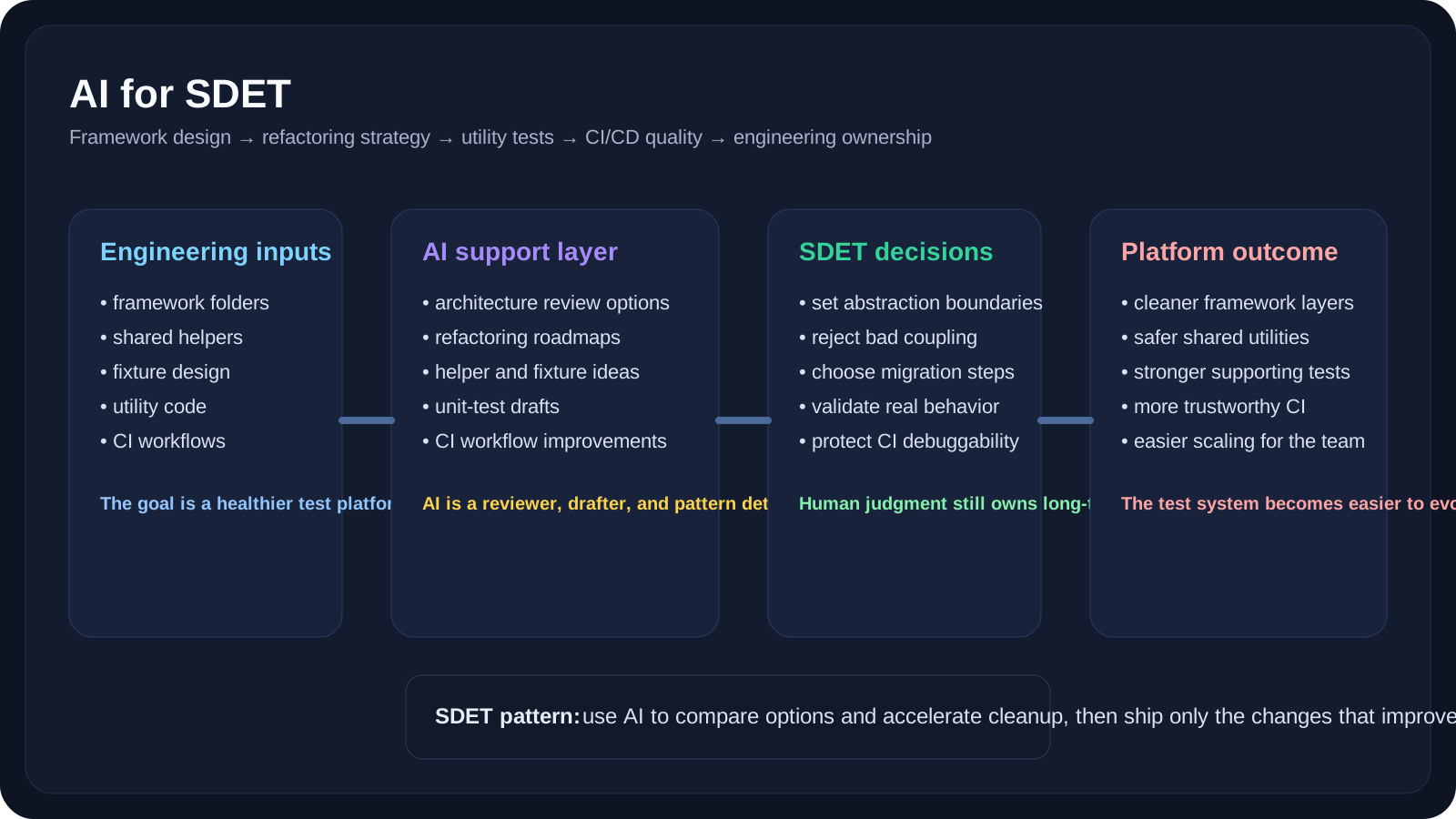
Use AI for test framework design, architecture reviews, refactoring strategy, unit-test support, and CI/CD quality improvements.
Overview
This lesson closes Level 7 by moving one step beyond day-to-day automation implementation.
The earlier lessons showed how AI helps with:
- testing practice
- automation drafting
- UI automation
- API validation
- debugging and CI workflows
- tool selection
Now we shift into the SDET lens: how AI helps you improve the test system itself.
That means thinking less about one individual test and more about:
- framework structure
- abstraction boundaries
- helper libraries
- unit and integration quality
- CI/CD design
- maintainability at scale
At this level, AI is no longer just a drafting assistant. It becomes a review partner, architecture sounding board, refactoring accelerator, and implementation helper. But the same rule still applies: AI can speed up engineering decisions, not replace engineering judgment.
A Practical Note for QA Engineers
If you are not yet working in a formal SDET role, do not skip this lesson. Many QA automation engineers are already doing SDET-style work without using the title.
If you regularly touch any of these areas, this lesson is relevant:
- framework folders and shared helpers
- reusable test utilities
- unit or API support code
- CI pipelines
- flaky suite cleanup
- engineering standards for tests
Learning Goals
- Understand how AI supports SDET-level responsibilities, not just individual test creation
- Use AI to review and improve framework architecture without blindly accepting design suggestions
- Refactor large automation codebases more systematically with AI support
- Generate stronger unit-test, integration-test, and utility-test coverage
- Improve CI/CD quality gates, workflow structure, and feedback loops
- Recognize where SDET judgment must stay human, especially around abstractions, coupling, and long-term maintainability
Core Concepts
How SDET Work Differs from Regular Test Authoring
An SDET usually works at a broader engineering layer than a test author.
Instead of only asking:
- "How do I automate this scenario?"
an SDET also asks:
- "Where should this logic live?"
- "What reusable abstraction should exist?"
- "How do we prevent duplication across the suite?"
- "How do we keep CI trustworthy?"
- "What engineering rule should our test code follow?"
AI can be useful here because these problems involve:
- repeated patterns
- structural reviews
- codebase comparisons
- cleanup opportunities
- draft implementations
But they also involve tradeoffs that AI cannot reliably decide alone:
- when abstraction is too early
- whether a helper hides too much business meaning
- whether a page object is too broad
- whether a shared fixture increases coupling
- whether a CI optimization harms debuggability
The Best AI Posture for SDETs
Use AI in SDET work as:
- a pattern detector
- a refactoring assistant
- a draft generator
- a review partner
- a workflow helper
Do not use AI as:
- the final architect
- the final source of framework standards
- the authority on your product’s testing boundaries
A Practical SDET Workflow with AI
Use this sequence:
- Describe the engineering goal clearly
- Show the current structure, not just the target idea
- Ask AI for options, not a single answer
- Compare tradeoffs before changing shared abstractions
- Apply changes in small reviewable steps
- Run tests and inspect CI evidence after every meaningful change
That workflow keeps AI useful without letting it push the framework into accidental complexity.
Where AI Helps Most for SDETs
| SDET Area | AI Value | Human Still Owns |
|---|---|---|
| Framework structure review | Finds duplication and layering ideas | Final architecture and boundaries |
| Refactoring planning | Suggests cleanup stages | Priority and migration strategy |
| Unit-test generation | Creates fast first drafts | Correct assertions and edge coverage |
| Test utility design | Drafts helper APIs | Long-term reuse and naming quality |
| CI workflow drafting | Produces starter YAML and steps | Security, secrets, runtime cost, policy |
| Code review support | Highlights smells and missing checks | Final merge judgment |
| Documentation | Summarizes patterns and usage | Accuracy and team standards |
12 Practical Examples
Example 1: Review framework folder structure
Prompt:
1Review this test automation framework structure.2Identify:3- duplicated responsibility4- overly broad modules5- unclear ownership boundaries6- missing shared layers7- areas where the framework may become hard to scale8Return your answer as:9- observations10- risks11- recommended structural changesThis is useful when the suite has grown organically and no longer feels coherent.
Example 2: Compare two architecture options
Ask AI to compare:
- page objects only
- page objects plus domain helpers
- fixtures plus lightweight action helpers
Then request:
- pros
- cons
- scaling risks
- when each model fits best
For SDETs, this is more valuable than asking AI to "pick the best pattern" with no tradeoff discussion.
Example 3: Generate a refactoring roadmap
If the suite has:
- repeated setup
- mixed assertion styles
- duplicate selectors
- hardcoded test data
ask AI to create a staged cleanup plan:
- low-risk cleanup
- medium-risk abstraction
- high-risk structural change
This helps teams avoid large, dangerous rewrites.
Example 4: Draft a shared fixture strategy
Prompt:
1Given this Playwright test suite, suggest a fixture strategy that:2- removes duplicate login/setup3- keeps tests readable4- avoids over-coupling unrelated tests5- supports future scaling6Return:7- fixture candidates8- anti-pattern warnings9- migration stepsThis is helpful because AI can often spot repeated setup faster than a human first pass.
Example 5: Generate unit tests for test utilities
SDETs often own helper libraries that also need testing.
Ask AI to generate unit tests for:
- data transformers
- request builders
- custom assertion helpers
- environment parsers
- retry utilities
Then manually review:
- edge coverage
- failure assertions
- naming quality
- false assumptions
Example 6: Improve custom assertion design
If your framework has vague helpers like:
1await verifyOrder(page)ask AI:
1Review this helper API.2Explain whether the abstraction is too vague.3Suggest clearer method names and assertion boundaries.4Do not add hidden business logic.This is one of the best SDET uses of AI because naming and boundary clarity matter a lot at scale.
Example 7: Review test-data strategy
Ask AI to inspect how your framework handles:
- static fixtures
- generated users
- environment-specific records
- seeded data
- cleanup rules
Then ask for:
- risks of brittle shared data
- opportunities for builder/factory patterns
- safer isolation strategies
Example 8: Generate CI workflow improvements
Prompt:
1Review this GitHub Actions workflow for a test suite.2Suggest improvements for:3- caching4- test parallelism5- artifact upload6- failure diagnostics7- environment separation8- maintainability9Do not weaken debuggability for speed.This helps avoid the common mistake of optimizing runtime while making failures harder to understand.
Example 9: Draft a code-review checklist for test code
SDETs can use AI to produce repeatable review standards such as:
- selector quality
- assertion clarity
- retry misuse
- helper duplication
- fixture abuse
- unclear naming
- CI evidence quality
Then convert that into a team review checklist.
Example 10: Convert one-off helpers into a pattern library
Ask AI to inspect multiple helper files and identify:
- duplicate responsibilities
- naming collisions
- overlapping abstractions
- reusable utility categories
Then use the output to define a cleaner internal library structure.
Example 11: Generate migration support for a legacy suite
If the team is moving from Selenium to Playwright, or from ad hoc API tests to a proper framework, AI can help create:
- migration checklists
- compatibility notes
- feature mapping docs
- draft replacement examples
- staged rollout plans
That is much safer than attempting a single AI-generated "full migration."
Example 12: Turn engineering notes into framework documentation
SDETs often leave framework knowledge trapped in code and tribal memory.
Use AI to turn:
- README notes
- helper usage examples
- fixture rules
- CI expectations
- contribution guidelines
into cleaner internal documentation for the team.
QA and SDET Role Perspectives
Manual QA Perspective
Even if you do not write framework code daily, this lesson helps you understand why the automation platform behaves the way it does.
It also helps you contribute better inputs:
- clearer reusable scenarios
- more stable expected results
- better defect reproduction notes
- more useful requests for automation support
Automation QA Engineer Perspective
This lesson is where an automation engineer starts thinking beyond "my next test" and toward:
- shared abstractions
- framework hygiene
- refactoring strategy
- CI trust
That transition is often what separates a growing automation engineer from a stronger SDET-level contributor.
SDET Perspective
For SDETs, AI is most useful when it helps you:
- see structural problems faster
- compare architecture options
- reduce refactoring cost
- create stronger supporting tests
- document standards more clearly
The quality bar is higher here than in basic prompting or test drafting. Strong SDET use of AI is not about generating more code. It is about improving the engineering system around the tests.
Practical Work
Exercise 1: Review Your Framework Like an SDET
Your task: Use AI to perform a framework review on one real automation project.
Steps:
- Select one framework area such as:
- fixtures
- page objects
- API helpers
- test data
- CI workflows
- Paste the relevant structure or representative files into your AI tool.
- Ask for:
- duplication risks
- unclear boundaries
- naming issues
- scaling concerns
- low-risk improvements
- Mark which recommendations are:
- immediately useful
- useful but premature
- misleading for your codebase
Exercise 2: Build a Refactoring Plan, Not a Rewrite
Your task: Use AI to plan a safe cleanup for one weak part of the suite.
Steps:
- Choose one messy area such as repeated setup or fragile helpers.
- Ask AI for a three-stage plan:
- easy wins
- medium-risk cleanup
- structural improvements
- Reject any suggestion that:
- hides business meaning
- creates massive coupling
- is too large to review safely
- Execute only the smallest safe improvement first.
Exercise 3: Improve a CI Workflow with Guardrails
Your task: Use AI to improve one testing workflow in CI without losing debuggability.
Steps:
- Take one existing CI workflow file.
- Ask AI to improve:
- readability
- caching
- artifact collection
- failure visibility
- Compare the AI result against your actual team needs.
- Keep the changes only if they improve both:
- maintainability
- failure diagnosis quality
Reference Links
- GitHub Copilot documentation
- Best practices for using GitHub Copilot
- Playwright Best Practices
- Playwright Page Object Models
- Playwright Authentication
- GitHub Actions documentation
- Workflow syntax for GitHub Actions
- OpenAI Prompt Guidance
- OpenAI Structured Outputs
Key Takeaways
- SDET-level AI usage is about improving the engineering system around tests, not only generating more test files.
- AI is strongest when reviewing structure, spotting repetition, drafting safe refactoring plans, and accelerating utility or CI work.
- Framework boundaries, abstraction quality, and long-term maintainability still require strong human engineering judgment.
- The safest SDET workflow is incremental: ask for options, review tradeoffs, apply small changes, and validate with real test runs.
- This lesson completes Level 7 by moving from task-level QA assistance to engineering ownership of the test platform itself.
Next Step
Level 8 moves beyond AI-assisted engineering into AI Agents. There, the question changes from "How can AI help me do this task faster?" to "How can AI systems plan, call tools, retain context, and coordinate multi-step QA workflows?"