Multi-Agent Systems for QA
Learn when multiple specialist agents make sense for QA, and how handoffs, roles, and coordination affect reliability.
Overview
Once teams understand a single-agent workflow, the next temptation is obvious:
Should we split the work across multiple specialist agents?
Sometimes the answer is yes.
Anthropic’s research-system writeup is one of the best real-world examples here. Their multi-agent system used specialist agents in parallel to explore complex topics more effectively than one overloaded agent. That same pattern can be useful in QA, but only when specialization solves a real coordination problem.
A Practical Note for QA Learners
More agents do not automatically mean a better design.
A multi-agent system only makes sense when:
- one agent becomes too broad
- handoffs can be clearly defined
- specialists add real clarity
- shared state can stay coherent
If those things are not true, multiple agents often create more confusion than value.
Learning Goals
- Understand when multi-agent design is justified
- Define clean specialist-agent boundaries
- Recognize handoff and shared-state risks
- Apply multi-agent patterns to QA use cases
- Avoid unnecessary orchestration overhead
Why Split Work Across Agents?
Common reasons:
- one agent has too many responsibilities
- different steps need different instructions or tools
- tasks can run in parallel
- results benefit from specialist review
QA Example
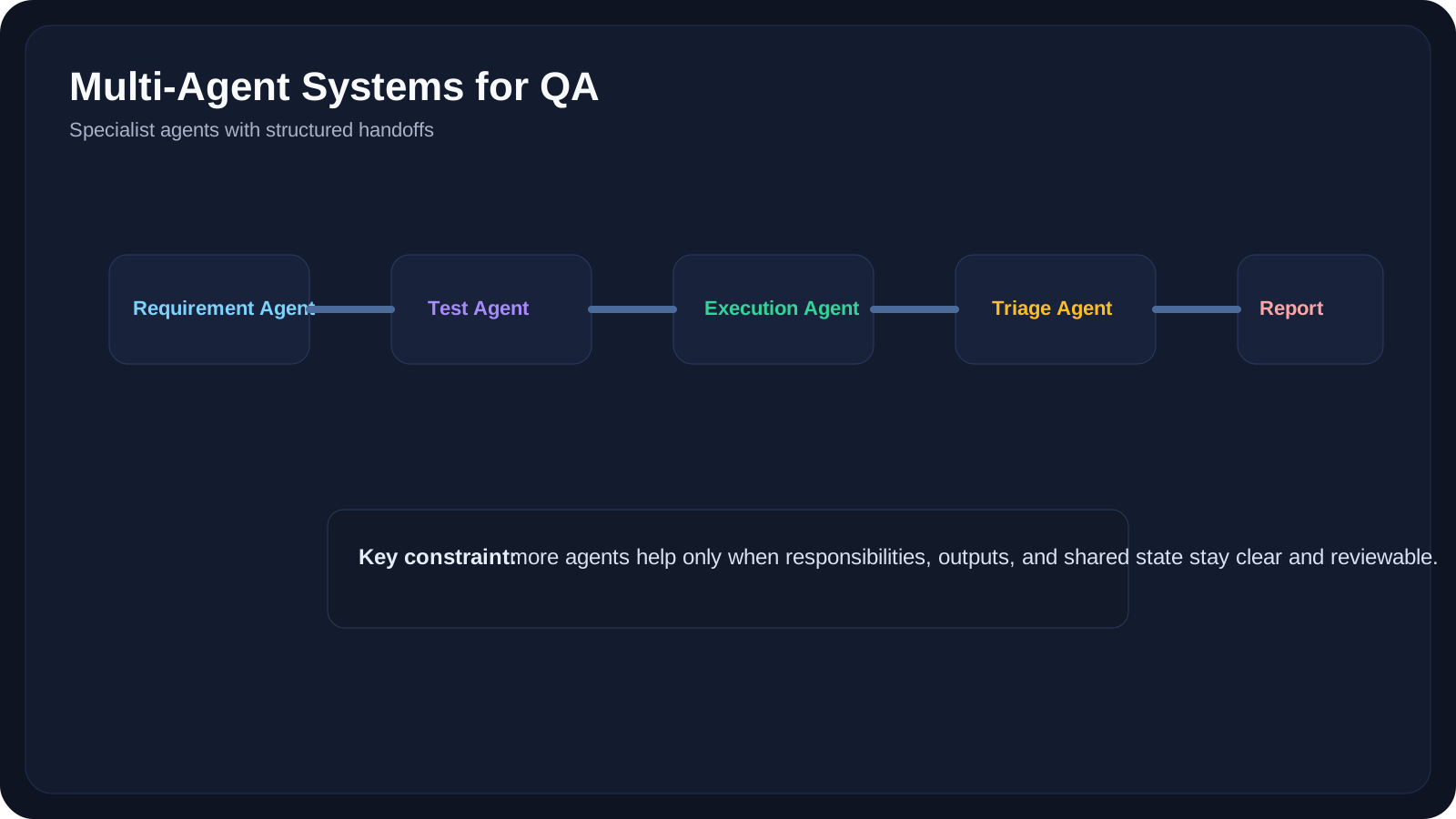
Instead of one giant release agent, you may have:
- requirement review agent
- test design agent
- execution evidence agent
- defect triage agent
- reporting agent
That can improve clarity if the handoffs are explicit.
But It Also Creates Costs
- more moving parts
- more state to coordinate
- more failure modes
- harder debugging
That is why multi-agent should be earned, not assumed.
10 QA-Friendly Examples
Example 1: Requirement Analyst + Test Designer
One agent extracts risks.
Another converts those risks into test scenarios.
Example 2: Failure Investigator + Reporting Agent
One agent reads traces and logs.
Another turns findings into a QA-facing summary.
Example 3: API Reviewer + Data Validator
One agent inspects schema changes.
Another focuses on downstream data effects.
Example 4: Release Collector + Approval Draft Agent
One gathers evidence.
Another assembles the decision-ready report.
Example 5: Onboarding Assistant Pair
One agent handles documentation lookup.
Another handles environment readiness steps.
Example 6: Browser Agent + Contract Agent
One checks visible UI behavior.
Another validates backend contract behavior.
Example 7: Defect Classifier + Duplicate Hunter
One labels the issue type.
Another looks for similar known incidents.
Example 8: Security Review Agent + QA Agent
One checks prompt/tool boundaries.
Another checks test and release impact.
Example 9: Historical Signal Agent + Current Run Agent
One uses past failures.
Another focuses on the current run’s fresh evidence.
Example 10: Research Agent + Decision Agent
One gathers information broadly.
Another makes the recommendation draft from the gathered evidence.
Handoffs Matter More Than Titles
The most important design question is not:
What cool agents should we invent?
It is:
What exact output does one agent pass to the next?
Good handoffs should be:
- structured
- limited
- testable
- easy to review
Examples:
- risk list
- scenario table
- failure classification
- release evidence packet
Bad handoffs are vague prose blobs with no clear schema.
Common Failure Modes
Failure 1: Overlapping Responsibility
Two agents both try to do triage or both try to generate test scenarios.
Failure 2: Bad Handoffs
One agent outputs too much noise or too little structure for the next one.
Failure 3: State Drift
Different agents operate from inconsistent task state.
Failure 4: Recursive Complexity
The system keeps adding agents instead of improving one weak workflow.
Failure 5: Debugging Pain
When the final answer is wrong, it becomes hard to identify which agent made the key mistake.
Practical Work
Exercise 1: Justify the Split
Take one QA workflow and explain whether it should stay:
- single-agent
- two-agent
- multi-agent
Your answer must include:
- why the split helps
- what each specialist owns
- what shared state is required
Exercise 2: Define One Structured Handoff
Choose two agents and define the exact handoff payload.
Example fields:
- requirement summary
- top risks
- scenario list
- approval flag
Exercise 3: Find the Simplification
Review your design and remove one unnecessary agent.
Explain why the simpler version is safer.
Reference Links
- Anthropic: How We Built Our Multi-Agent Research System
- OpenAI Agents SDK Orchestration
- LangGraph Overview
- Microsoft Semantic Kernel GitHub
YouTube Resources
- Anthropic: How to Build Multi Agent Systems
- Multi-Agent Systems Explained
- LangGraph Multi-Agent Tutorial
Key Takeaways
- Multi-agent systems should solve a real coordination problem, not just add novelty.
- Clear specialist boundaries and structured handoffs matter more than agent labels.
- Shared state and observability become more important as more agents are added.
- If a single agent can do the work safely, that is often the better design.
- For QA teams, multi-agent is most useful when evidence gathering, analysis, and reporting have genuinely different needs.
Next Step
The final lesson of Level 8 is Evaluating and Operating AI Agents, where we focus on traces, observability, quality scoring, runtime safety, and operational trust.