Context Engineering and Grounding
Learn how to select, rank, and inject context so model outputs stay relevant, evidence-based, and testable.
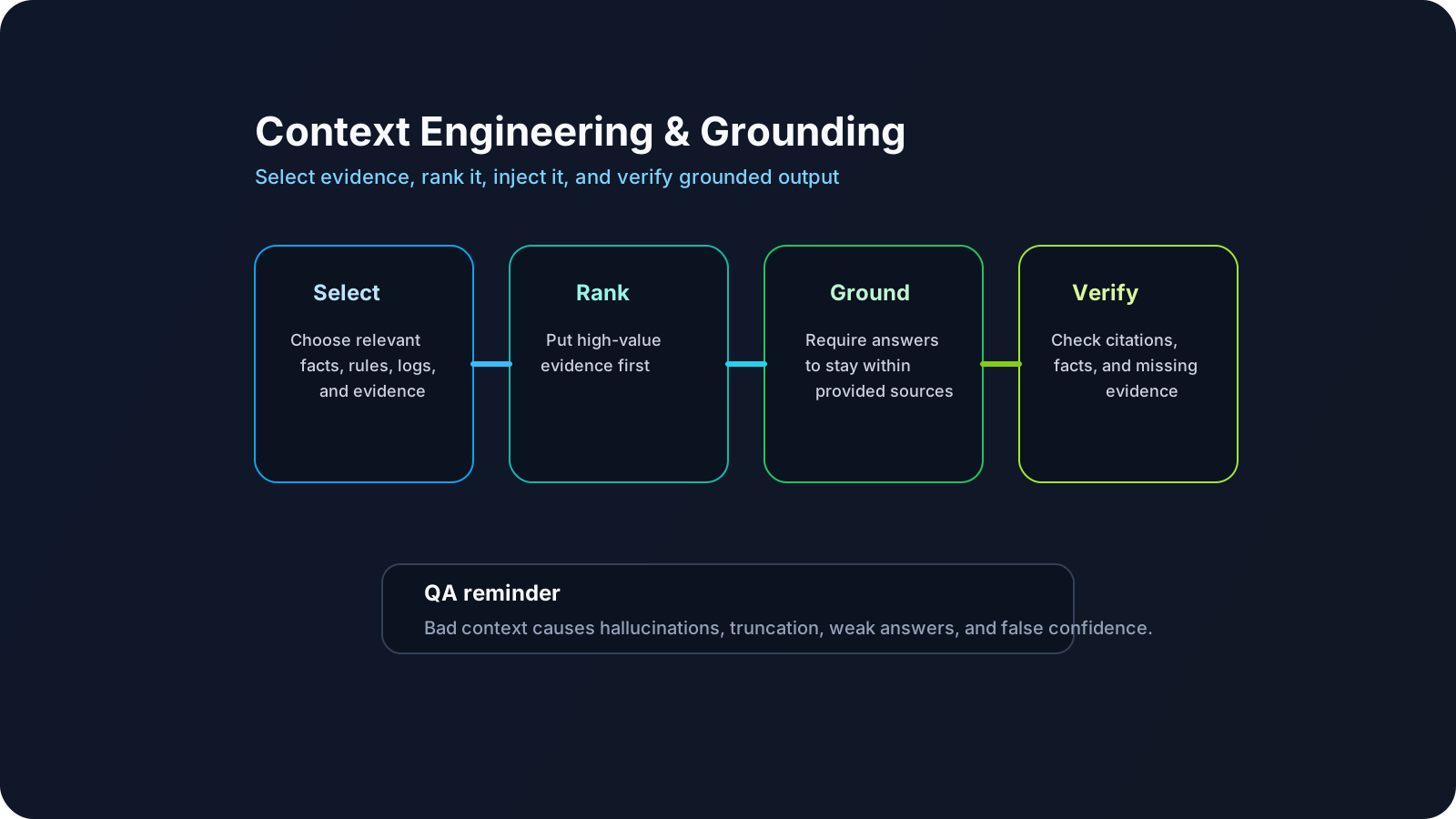
Overview
Prompt quality depends on context quality. Even a well-written prompt can fail if the model receives noisy logs, outdated rules, duplicated instructions, or missing evidence. In many real workflows, the quality of the context matters more than the cleverness of the prompt.
This lesson explains how to select useful context, reduce noise, apply grounding constraints, and test whether an output is truly supported by evidence.
A Practical Note for QA Learners
This lesson is one of the most useful in the whole Prompt Engineering section because many AI failures are really context failures.
For practical QA work, three ideas matter most:
- include only the evidence the model actually needs
- force the model to stay grounded in provided sources
- test what happens near context limits and under noisy input
Learning Goals
- Distinguish relevant context from noise.
- Apply grounding constraints to reduce unsupported output.
- Understand how context ranking affects answer quality.
- Test context-window edge behavior with realistic payloads.
- Build QA checks for evidence-based AI workflows.
Core Concepts
1. What Context Engineering Means
Context engineering is the process of deciding what information to include, what to exclude, what order to present it in, and how to tell the model to use it.
That can include:
- feature requirements
- acceptance criteria
- logs
- tickets
- retrieved documents
- tool outputs
- policy text
The goal is not to send more text. The goal is to send the right text in the right order.
2. More Context Is Not Always Better
Extra context can hurt by:
- burying important rules
- increasing distraction
- pushing the prompt near token limits
- mixing high-value and low-value evidence together
Bad context design often leads to hallucinations, dropped rules, weak summaries, and false confidence.
3. Context Selection
Ask before sending context:
| Question | Why it matters |
|---|---|
| Is this required for the task? | Irrelevant context adds noise |
| Is this source trustworthy? | Low-quality evidence creates low-quality output |
| Is this current? | Stale context causes outdated answers |
| Is there duplication? | Repetition wastes token budget |
| Is the key rule easy to find? | Buried facts are often ignored |
4. Ranking and Ordering
High-value evidence should usually appear earlier and more clearly than low-value material.
Examples of high-priority context:
- official business rules
- latest acceptance criteria
- confirmed source evidence
- schema or field definitions
Low-priority context:
- duplicate logs
- stale assumptions
- unrelated background notes
5. Grounding Constraints
Grounding means anchoring the answer to supplied evidence instead of allowing invention.
Useful constraints:
1Answer only from the provided sources.2If the evidence is missing, say "Not enough evidence."3Do not infer missing business rules.For higher-control workflows:
1Answer using only the retrieved excerpts.2Cite the source section IDs used for each claim.3If a claim cannot be supported, mark it as unsupported.6. Context Window Awareness
A model can only use what fits in its context window. That includes:
- system or developer instructions
- user request
- retrieved documents
- tool outputs
- previous turns
- the generated answer itself
QA should test:
- near-limit input cases
- truncation behavior
- rule loss under long context
- answer quality with compact vs bloated context
7. Common Context Failure Modes
| Failure mode | Example |
|---|---|
| Noise overload | Extra logs drown out the actual error |
| Stale evidence | Model uses an old policy version |
| Conflicting sources | Two documents disagree and no resolution rule is given |
| Missing support | Model answers beyond available evidence |
| Buried rule | Key acceptance rule is hidden in a long input |
QA/SDET Relevance
Manual QA should test:
- whether answers stay grounded in provided evidence
- whether long context changes quality
- whether retrieved content is actually used
- whether uncertainty is expressed when evidence is incomplete
Automation and SDET teams should test:
- prompt truncation boundaries
- citation presence and accuracy
- retrieval ranking quality
- groundedness and hallucination metrics
- performance differences with full vs filtered context
Practical Work
Exercise: Context Quality Comparison Lab
Choose one workflow such as support-ticket summarization, requirement-to-test generation, or defect triage summary.
Create three variants:
- raw full context
- filtered context
- ranked context plus grounding rule
Measure:
- hallucination rate
- factual accuracy
- completeness
- usefulness for QA
Reflection
- Which version produced the most trustworthy output?
- What context could safely be removed?
- Which facts disappeared near the context boundary?
Recommended Resources
Key Takeaways
- Context engineering is one of the biggest quality levers in AI workflows.
- The right evidence matters more than simply adding more text.
- Grounding constraints reduce unsupported answers and make uncertainty explicit.
- QA teams should test context quality, ranking, and token-limit behavior directly.
- A strong prompt still fails if the context is noisy, stale, or incomplete.
Next Step
Continue to Few-Shot and Example-Driven Prompts to learn how examples can stabilize output format, tone, and coverage.