Prompts for Defect Analysis and Triage
Use prompt templates to summarize defects, cluster duplicates, infer probable causes, and prioritize triage actions.
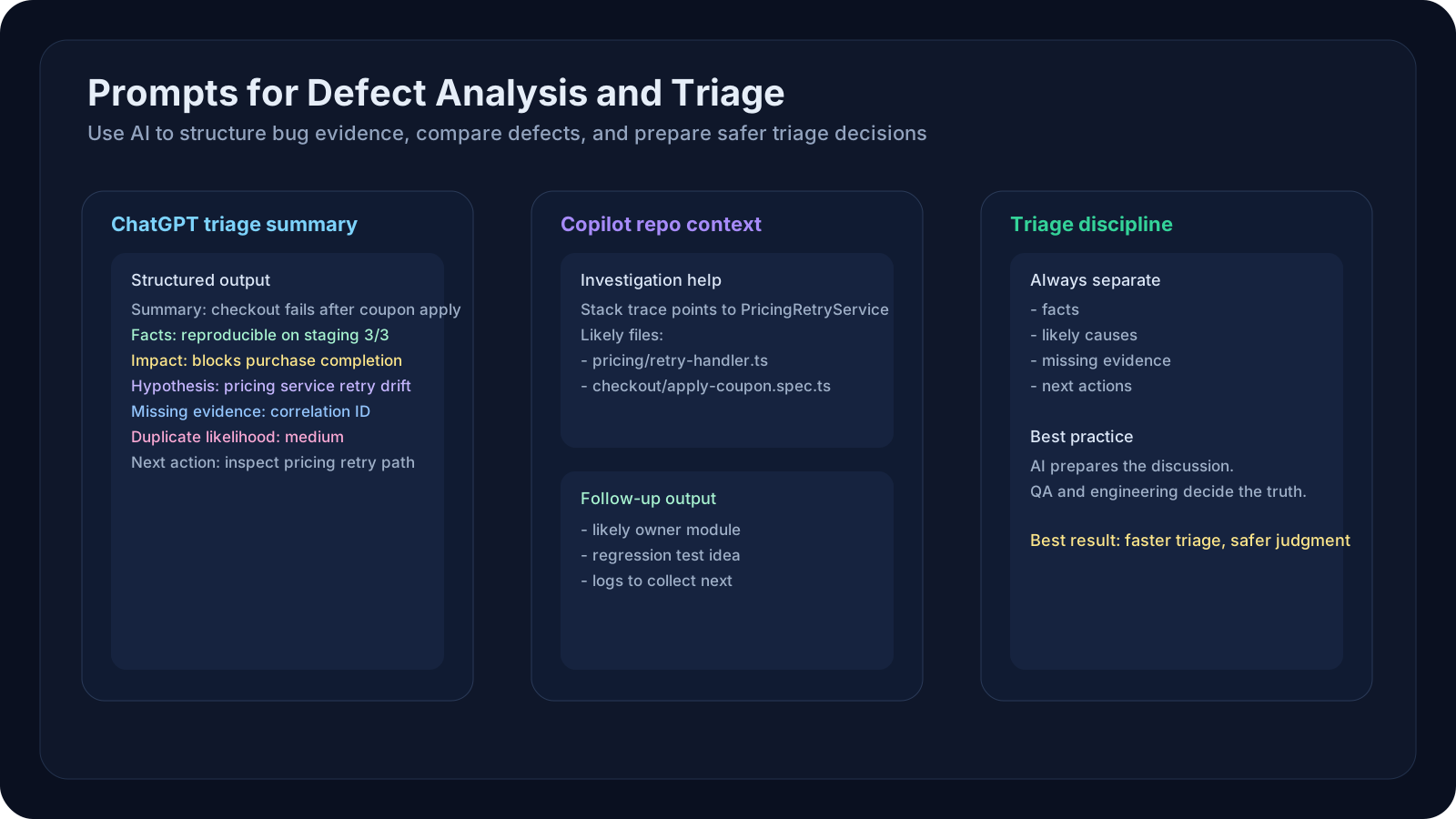
Overview
Defect triage is where AI can save a large amount of time and also cause serious mistakes if used carelessly. A model can summarize logs beautifully and still jump to the wrong root cause.
The goal of prompt engineering in defect triage is not to replace debugging. It is to help QA teams:
- structure evidence
- spot likely duplicates
- identify missing information
- prepare better triage conversations
- speed up release decisions
A Practical Note for QA Learners
If you want the safest takeaway from this lesson, use AI to:
- summarize
- compare
- classify
- highlight gaps
Do not use AI to declare a root cause as fact unless engineers and evidence confirm it.
Learning Goals
- Use ChatGPT and Copilot to improve defect summaries and triage readiness.
- Separate facts, observations, hypotheses, and recommendations.
- Generate duplicate-detection prompts that are useful rather than overconfident.
- Support manual QA and automation teams during bug investigation.
- Turn logs, repro steps, PRDs, and code context into clearer next actions.
Core Concepts
1. Separate Facts from Hypotheses
Every strong defect prompt should keep separate sections for:
- observed behavior
- expected behavior
- reproduction steps
- evidence
- probable causes
- missing evidence
This reduces the risk of AI presenting a guess as a conclusion.
2. Triage Output Should Be Action-Oriented
Good output answers:
- what do we know?
- what do we not know?
- who should investigate next?
- how severe is the issue?
- what evidence is still missing?
- is this likely a duplicate?
3. ChatGPT and Copilot Have Different Strengths
ChatGPT is stronger for:
- natural-language bug summary
- comparison across multiple defects
- release-risk explanation
- turning messy bug notes into structured triage artifacts
Copilot is stronger for:
- reading stack traces next to code
- suggesting likely files or modules to inspect
- helping connect logs to implementation details
- drafting unit or integration test ideas from bug evidence
4. Good Triage Prompts Ask for Uncertainty
Include instructions like:
- assign confidence level
- distinguish facts from inference
- list missing evidence
- give 2 to 3 plausible causes, not one forced conclusion
ChatGPT vs Copilot in Triage
| Task | ChatGPT | Copilot / GitHub Copilot Chat | Why |
|---|---|---|---|
| Clean up a messy bug report | Strong | Medium | Better for natural language restructuring |
| Compare 2 to 5 suspected duplicate bugs | Strong | Medium | Better at cross-report reasoning |
| Summarize logs for non-engineering stakeholders | Strong | Medium | Better explanation style |
| Inspect stack trace with repo context | Medium | Strong | Copilot sees local code |
| Suggest likely modules to inspect | Medium | Strong | IDE context matters |
| Turn a defect into regression test ideas | Strong | Strong | Both useful depending on context |
Prompt Patterns for Better Triage
Pattern 1: Evidence-First Defect Summary
1You are helping a QA lead prepare a triage summary.23Based on the defect details below, return:4- concise summary5- observed behavior6- expected behavior7- affected areas8- evidence provided9- missing evidence10- likely business impact1112Do not guess the root cause unless supported by the evidence.Pattern 2: Duplicate Detection
1Compare these two defect reports and assess whether they are likely duplicates.23Compare:4- error messages5- affected modules6- reproduction steps7- environment8- timing9- user impact1011Return:12- duplicate likelihood13- similarities14- differences15- missing evidence needed before merging themPattern 3: Root-Cause Hypothesis with Uncertainty
1Using the defect report, logs, and stack trace below:2- list 2 or 3 plausible causes3- label each as hypothesis, not fact4- assign confidence5- state what additional evidence would confirm or reject itPractical Examples
Example 1: ChatGPT for Bug Report Cleanup
Use when a defect is written in mixed notes or chat fragments.
Prompt:
1Rewrite this raw bug report into a clean QA defect summary with sections for2summary, environment, repro steps, observed result, expected result, evidence, and impact.Example 2: ChatGPT for Release-Risk Summary
Prompt:
1Summarize this defect for a release manager.2Explain customer impact, affected workflow, severity rationale, and whether the issue blocks release.Example 3: ChatGPT for Duplicate Candidate Review
Use when several similar bug tickets exist around the same feature.
Example 4: ChatGPT for Missing Evidence Detection
Ask:
1What important evidence is missing from this defect report that would improve triage quality?Example 5: ChatGPT for PRD Comparison
Prompt:
1Compare this defect report with the PRD expectations.2Identify whether the bug reflects incorrect implementation, ambiguous requirements, or missing acceptance criteria.Example 6: ChatGPT for User-Facing Impact Description
Useful for:
- support teams
- product owners
- release leads
Example 7: ChatGPT for Severity Calibration
Prompt:
1Suggest severity and priority for this issue based on business impact, reproducibility, and affected user scope.2Also mention what information could change that decision.Example 8: ChatGPT for Test Case Backfill
Prompt:
1Convert this defect into regression test ideas for manual QA and automation QA.Example 9: Copilot for Stack Trace Investigation
In the IDE:
1Review this stack trace and point to the most likely files or functions in this repository that should be inspected first.2Explain why.Example 10: Copilot for Failure Path Mapping
Prompt:
1Based on this failing API response and the related service code, list the checkpoints where the request could fail.Example 11: Copilot for Regression Test Draft
Prompt:
1Using this resolved defect and the surrounding code, create a regression test outline that would likely catch this bug in the future.Example 12: Copilot for Log-to-Code Mapping
Useful when:
- the bug includes exception names
- the repo has consistent logging
- the code path is not obvious
Example 13: Manual QA Workflow Example
Use ChatGPT to:
- clean the defect
- summarize evidence
- compare against PRD
- suggest severity rationale
Manual QA then:
- confirms reproduction accuracy
- adjusts severity based on real product impact
- adds business nuance AI does not know
Example 14: Automation QA Workflow Example
Use ChatGPT to:
- identify regression candidates
Use Copilot to:
- map the bug to likely test layer
- draft automation scaffolds or failure assertions
Example 15: Defect Cluster Review
Prompt:
1Group these 12 recent bugs into likely themes such as auth, validation, flaky UI, timing, and environment issues.2Return a short explanation for each cluster.Example 16: Bug Triage Meeting Prep
Use AI to produce:
- one-line summary
- likely owner team
- risk level
- evidence completeness
This makes triage meetings more efficient.
Example 17: Test Data Reproduction Pack
Prompt:
1Based on this bug, propose the minimum test data set needed to reproduce the issue consistently.Example 18: Cross-Environment Difference Review
Ask:
1Given these reports from staging and production, summarize what differs in behavior and what environment-specific factors should be checked.Example 19: Postmortem Draft Support
Use ChatGPT to create a first-pass structure for:
- incident summary
- timeline
- impact
- contributing factors
- follow-up actions
Example 20: Executive Summary for Leadership
Prompt:
1Write a short, non-technical summary of this defect cluster for engineering leadership.2Focus on customer impact, release risk, and what the team is doing next.Tool-Specific Prompt Set
ChatGPT Prompt: Structured Triage Summary
1Act as a QA triage assistant.23Using the defect report, logs, screenshots, and PRD notes below, return:4- summary5- observed behavior6- expected behavior7- evidence8- suspected duplicate links9- severity suggestion10- missing information11- next actions1213Separate facts from hypotheses.Copilot Prompt: Repo-Aware Investigation Help
1Using the stack trace and repository context, identify likely code paths involved in this bug.2Point to the modules, conditions, and tests that should be reviewed first.3Do not claim certainty where evidence is weak.Manual QA Perspective
Manual QA gains:
- faster cleanup of low-quality bug reports
- better triage preparation
- stronger release-risk communication
- easier conversion of defects into regression ideas
Manual QA still owns:
- reproduction truth
- severity judgment
- business context
- stakeholder communication nuance
Automation QA / SDET Perspective
Automation teams gain:
- better regression candidate identification
- easier mapping from defect to test layer
- stronger log and evidence interpretation
- faster conversion from bug to automated guardrail
They still need to own:
- test strategy
- failure isolation
- durable assertions
- code-level debugging decisions
Hands-On Lab
Lab: Historical Bug Triage Upgrade
Take 10 to 20 historical defects and create:
- cleaned-up summaries
- severity rationale
- duplicate clusters
- missing evidence list
- regression candidate list
- likely owner team suggestions
Suggested workflow:
- Use ChatGPT to structure and compare the defects.
- Use Copilot on 2 to 3 representative defects that include logs or stack traces.
- Compare AI suggestions with actual historical resolution outcomes.
- Record where AI was useful and where it overreached.
Reflection Questions
- Where did the model sound confident without enough evidence?
- Which bug fields improved triage quality the most?
- Which defects were better suited to ChatGPT than Copilot, or vice versa?
- What rules should your team enforce in future triage prompts?
Recommended Resources
- GitHub Copilot documentation
- Microsoft Copilot documentation
- OpenAI prompt engineering guide
- Atlassian bug triage guide
- Google SRE resources
- Ministry of Testing
Key Takeaways
- AI is excellent at structuring and comparing defect information, but not at owning root-cause truth.
- ChatGPT is strongest for narrative cleanup, comparison, and release communication.
- Copilot is strongest for repo-aware debugging support and regression test follow-up.
- The best triage prompts separate facts, hypotheses, and missing evidence.
- Regression ideas and release summaries are high-value follow-up outputs.
- Human QA and engineering judgment remain the final authority.
Next Step
Continue to Prompt Workflows with Tools and RAG for more complex multi-step prompt orchestration and knowledge-grounded workflows.