Prompt Workflows with Tools and RAG
Compose prompts across retrieval, tools, and validation steps for higher-accuracy production workflows.
Overview
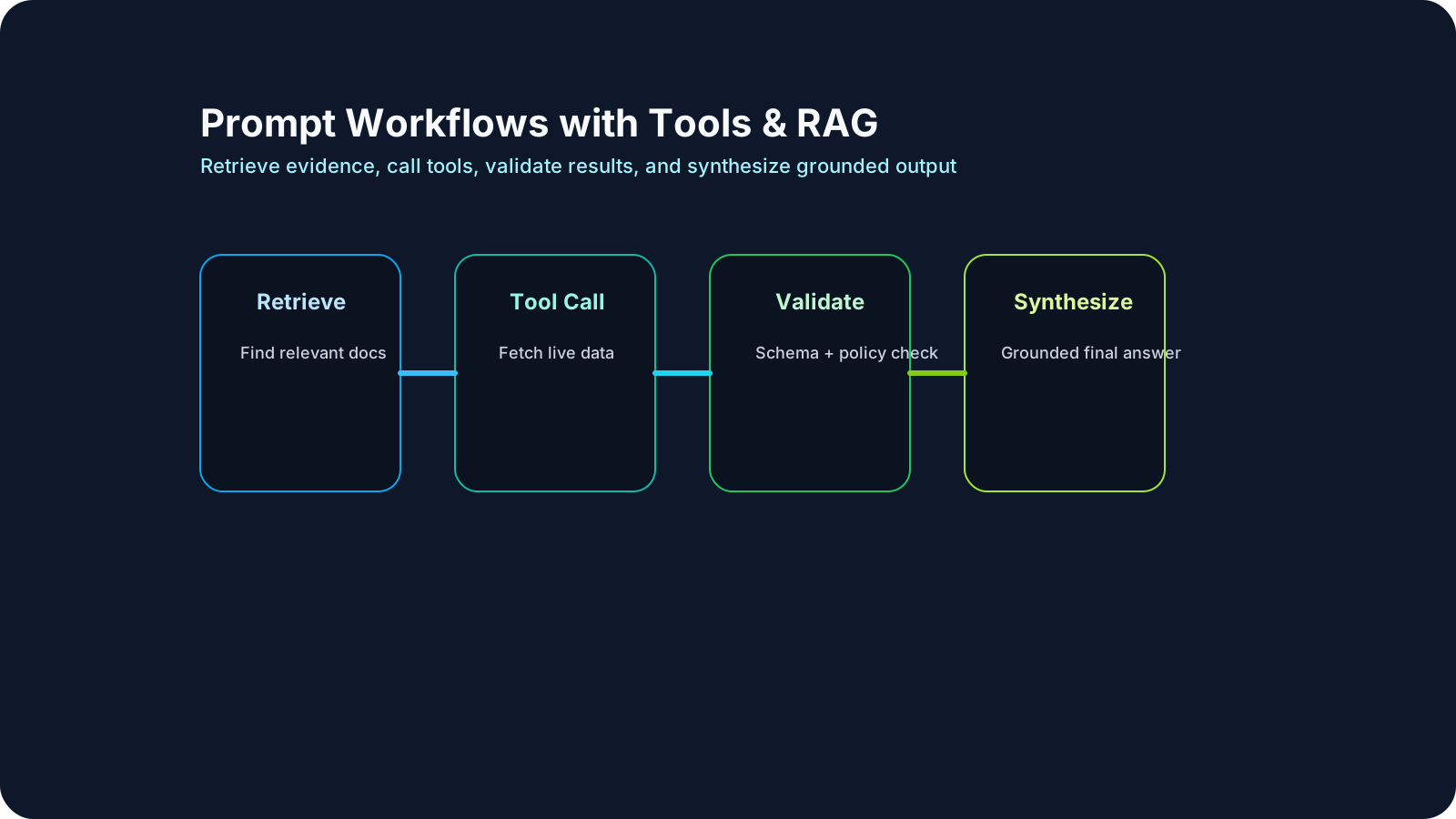
Real AI systems are multi-step. Instead of asking one model to do everything at once, production workflows often retrieve evidence, call tools, validate outputs, and then synthesize a final response.
This lesson teaches how to design those prompt workflows so they are more reliable, more grounded, and easier to test.
A Practical Note for QA Learners
If a single prompt starts failing under complexity, do not only rewrite the wording. Sometimes the real fix is to break the task into a workflow.
Learning Goals
- Design multi-step prompt chains for complex QA tasks.
- Integrate retrieval safely and deliberately.
- Use tool-aware prompts with clear execution boundaries.
- Add validation checkpoints between steps.
- Test workflow reliability end to end.
Core Concepts
1. Why Workflows Beat Single Prompts
Single prompts struggle when tasks require:
- external evidence
- live tool data
- structured validation
- multiple reasoning stages
Workflows help by separating those concerns.
2. Basic Workflow Pattern
Common flow:
- retrieve relevant evidence
- summarize or extract key facts
- generate output draft
- validate against schema or policy
- finalize response
3. Tool-Aware Prompting
When tools are involved, define:
- allowed tools
- allowed parameters
- fallback when tool fails
- how tool results should be interpreted
4. RAG Prompt Contract
Use grounding rules such as:
- answer only from retrieved evidence
- cite source references
- mark unsupported claims clearly
5. Validation Between Steps
Useful checkpoints:
- retrieval quality check
- schema validation
- groundedness check
- policy compliance check
QA/SDET Relevance
Manual QA should test:
- whether the final answer truly uses retrieved evidence
- whether tool failures degrade safely
- whether unsupported claims are rejected or flagged
Automation and SDET teams should test:
- retrieval ranking quality
- tool-call correctness
- step-level logging
- schema and citation validation
- end-to-end workflow regression
Practical Work
Exercise: Build a QA Assistant Workflow
Design a workflow that:
- retrieves internal testing-policy docs
- extracts relevant rules
- generates a release-readiness checklist
- validates that every checklist item maps to retrieved evidence
Reflection
- Which step added the most reliability?
- Which step created the biggest failure surface?
- Which validations should block release?
Recommended Resources
Key Takeaways
- Prompt workflows outperform single prompts on complex tasks.
- Retrieval and tool steps need explicit governance.
- Validation checkpoints are essential for production reliability.
- Workflow design is a prompt-engineering skill, not only an orchestration skill.
- QA should test the workflow as a system, not only the final output.
Next Step
Continue through the task-specific prompt lessons, then return to Advanced Prompt Engineering as the integrated capstone of the Prompt Engineering track.