Advanced Prompt Engineering
Explore few-shot prompting, decomposition, critique loops, structured output contracts, and robust QA prompt workflows.
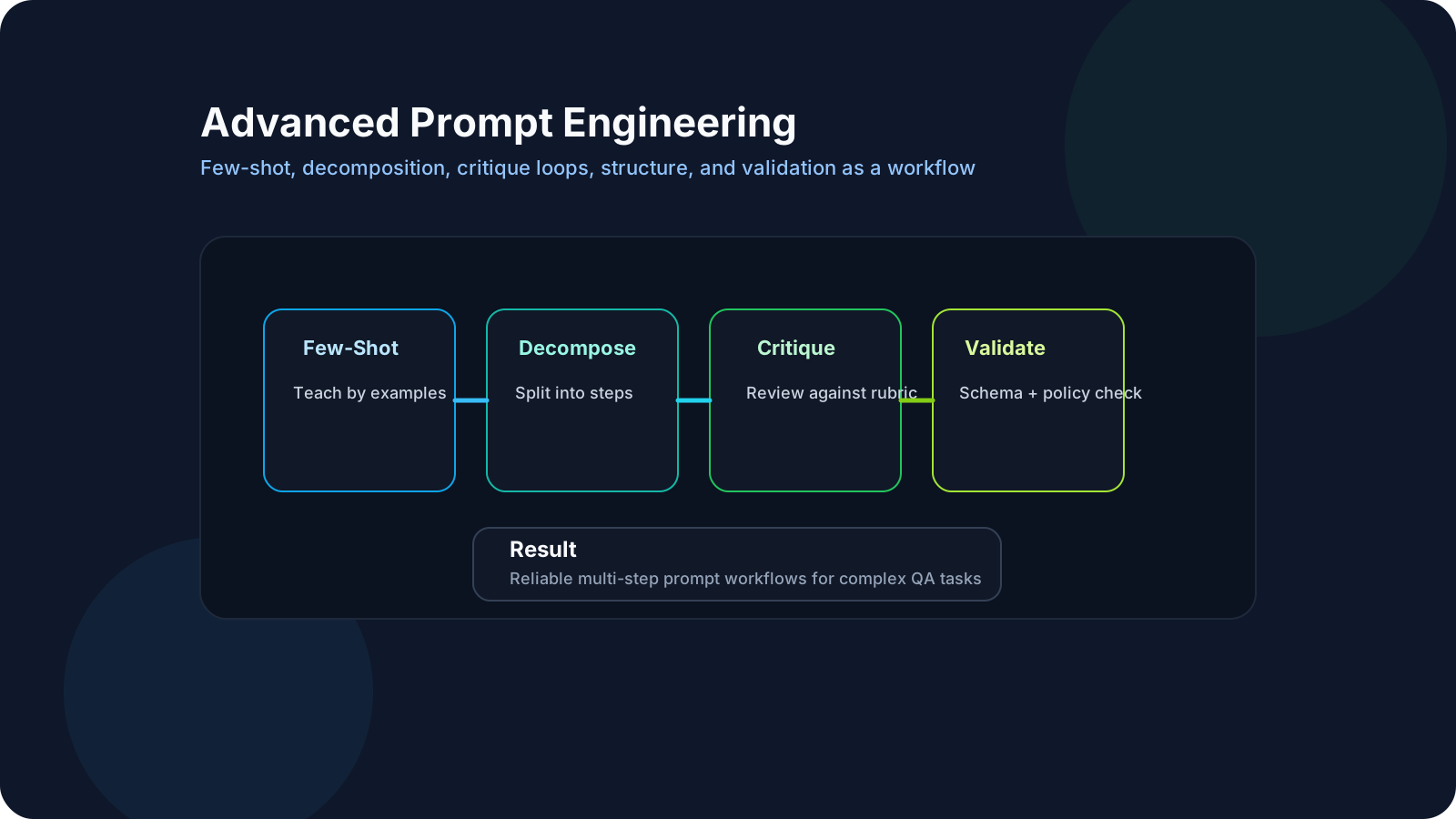
Overview
Advanced prompt engineering begins when one-shot prompting stops being enough. Instead of writing one instruction and hoping for the best, you start designing workflows that improve reliability, enforce structure, and recover from predictable failures.
For QA professionals, this is where prompting becomes an engineering discipline. You are no longer asking for output casually. You are designing repeatable prompt systems that can support automation, evaluation, and release decisions.
This lesson covers the practical patterns that matter most: few-shot prompting, decomposition, critique loops, structured outputs, robustness testing, and prompt workflows for QA tasks.
A Practical Note for QA Learners
This lesson is more advanced, but the goal is still practical. You do not need to use every advanced technique in every prompt. What matters is knowing which pattern helps when a basic prompt starts failing.
The most useful mindset is:
- start simple
- add structure only when needed
- evaluate whether the extra complexity actually improves reliability
If this feels dense, focus on few-shot prompting, decomposition, structured outputs, and the advanced workflow lab.
Learning Goals
- Apply few-shot and decomposition patterns to more complex QA tasks.
- Use critique-and-rewrite loops to improve output quality.
- Design prompts for structured, machine-validated outputs.
- Build robust prompts for regression-friendly QA workflows.
- Understand trade-offs between creativity, cost, and consistency.
Core Concepts
1. When Basic Prompting Stops Being Enough
Basic prompting often works for:
- summaries
- simple lists
- straightforward transformations
It starts to break down when you need:
- consistent structure
- multi-step reasoning
- coverage across multiple categories
- output that feeds automation
- quality that stays stable across prompt variations
That is where advanced techniques become useful.
2. Few-Shot Prompting
Few-shot prompting includes high-quality examples inside the prompt so the model can imitate style, structure, and depth.
Use it when:
- output format is strict
- domain language is specialized
- you want consistency across runs
- the model keeps missing the expected tone or detail level
Example:
1Task: Convert acceptance criteria into API test cases.23Example input:4Users can reset password using OTP. OTP expires in 10 minutes.56Example output:7[8 {9 "scenario": "Valid OTP within expiry window",10 "type": "positive",11 "expected_result": "Password reset succeeds"12 }13]Why it helps:
- examples reduce ambiguity
- examples show the desired structure directly
- examples are often stronger than abstract instructions alone
3. Task Decomposition
Complex tasks often become more reliable when split into stages.
Instead of:
1Analyze this feature and generate complete regression coverage.Use a staged flow:
- extract rules
- identify risks
- generate cases by category
- evaluate missing coverage
Example QA workflow:
| Step | Purpose |
|---|---|
| Requirement extraction | Pull explicit rules and constraints |
| Risk analysis | Identify negative, abuse, and edge areas |
| Test generation | Generate categorized cases |
| Review stage | Check for missing coverage |
Decomposition helps because the model works on smaller, clearer objectives at each step.
4. Critique and Self-Revision Loops
A useful advanced pattern is:
- draft response
- critique against rubric
- revise response
This often improves:
- requirement coverage
- consistency
- structure quality
- missing edge-case detection
Example critique prompt:
1Review the generated test cases against this checklist:21. Did they cover positive, negative, and boundary scenarios?32. Did they avoid invented fields or endpoints?43. Did they include abuse or security-relevant cases?5List missing coverage and rewrite the test set.For QA teams, this is especially useful for:
- test design
- defect summaries
- release-readiness analysis
- root-cause writeups
5. Structured Output Contracts
For automation workflows, natural-language output is often not enough.
Use structured output patterns when:
- output feeds a script or parser
- fields are mandatory
- invalid formatting breaks the workflow
Common patterns:
- JSON object
- JSON array
- Markdown table
- YAML block
Example:
1Return JSON only.2Each item must contain:3- id4- scenario5- category6- expected_result7Do not include explanation outside the JSON.This should always be paired with validation on the application side. Prompting helps, but parsing and schema validation are still required.
6. Multi-Objective Prompting
Real tasks often require multiple goals at once:
- correctness
- completeness
- safety
- brevity
- structure
Advanced prompts should prioritize those goals when they conflict.
Example:
1Priority order:21. Correctness32. Schema compliance43. Coverage of negative and boundary cases54. BrevityThis is useful because models often need help deciding which trade-off matters most.
7. Prompt Robustness Testing
If a prompt will be reused, test it the way you would test any other important artifact.
Run it against:
- paraphrased inputs
- noisy inputs
- long inputs
- missing fields
- conflicting instructions
- irrelevant context
Useful prompt-robustness matrix:
| Test style | What it reveals |
|---|---|
| Paraphrase test | wording sensitivity |
| Long-input test | context overflow or buried constraints |
| Noisy-input test | distraction sensitivity |
| Missing-field test | unsupported assumptions |
| Conflict test | instruction-priority behavior |
8. Prompt Workflows vs Single Prompts
At advanced levels, good AI behavior often comes from prompt pipelines rather than one large prompt.
Example QA pipeline:
- extract requirements
- generate test cases
- evaluate coverage
- rewrite missing areas
- output final structured result
Benefits:
- easier debugging
- clearer responsibility per stage
- more reliable outputs
- better fit for CI and automation
Trade-offs:
- more cost
- more latency
- more orchestration complexity
9. Prompt Versioning and Regression Packs
Once prompts are important to delivery, version them.
Track:
- prompt version
- target task
- known weak spots
- test dataset
- expected output quality band
A prompt regression pack should include:
- stable sample inputs
- paraphrased variants
- edge-case inputs
- output validation rules
- minimum quality thresholds
This is what turns advanced prompting into an engineering workflow instead of experimentation.
QA/SDET Relevance
Manual QA benefits:
- stronger exploratory scenarios from decomposed outputs
- better defect triage summaries via critique loops
- clearer prompt patterns for investigations and analysis
Automation and SDET benefits:
- schema-safe outputs for pipeline integration
- prompt regression packs with thresholds
- fail-fast validation when output quality drops
- reusable staged workflows for test generation and evaluation
A useful rule:
- if the prompt matters to delivery, it should be testable
- if it is reused, it should be versioned
- if it feeds automation, it should be validated
Practical Work
Exercise: Build an Advanced Prompt Workflow
Objective: Create a 3-step prompt workflow for a real QA task instead of relying on one large prompt.
Suggested task
Generate an API regression suite from feature requirements.
Step 1: Extractor prompt
Goal: Pull explicit rules, hidden constraints, and validation needs.
1Role: You are a QA analyst.2Task: Extract all rules, constraints, and validation needs from the requirement text.3Output format: Markdown table with Rule, Risk, Missing Clarification.Step 2: Generator prompt
Goal: Produce categorized test cases from the extracted rules.
1Role: You are a senior QA engineer.2Task: Generate positive, negative, boundary, and abuse-focused test cases using the extracted rules.3Constraints: Do not invent APIs or fields.4Output format: JSON array with scenario, category, expected_result.Step 3: Evaluator prompt
Goal: Review the generated cases for missing coverage.
1Role: You are a QA reviewer.2Task: Evaluate the generated test cases against this checklist: positive, negative, boundary, security, and failure recovery coverage.3Output format: Markdown with Coverage Score, Missing Areas, Rewrite Suggestions.Acceptance Criteria for the Workflow
- output parses successfully
- required coverage buckets are present
- no invented API fields or unsupported rules appear
- evaluator identifies missing coverage clearly
- final response is reusable in later runs
Robustness Extension
After the first version works, test it against:
- paraphrased requirements
- missing rules
- extra noisy notes
- long requirement text
- conflicting business constraints
Reflection
- Which step of the workflow improved quality the most?
- Where did most failures happen: extraction, generation, or evaluation?
- Which pieces could be automated in CI?
Recommended Resources
Official docs and guides
- OpenAI text generation guide
- OpenAI evals guide
- Anthropic prompt engineering overview
- Hugging Face chat templating guide
- OpenAI Academy: Advanced Prompt Engineering
Practical references
Books
- *Designing Machine Learning Systems* by Chip Huyen
- *Generative AI with LangChain* by Ben Auffarth
YouTube Resources

What this helps with: Helps connect advanced prompt strategies to real workflow concerns such as decomposition, constraint handling, and multi-step reasoning.
Key Takeaways
- Advanced prompting is workflow design, not one-shot prompt writing.
- Few-shot examples, decomposition, and critique loops improve reliability.
- Structured outputs and validators are essential when prompts feed automation.
- Prompt robustness testing matters before reuse at scale.
- The most useful prompt systems are versioned, evaluated, and treated like engineering assets.
Next Step
Review Level 5 as a connected toolkit, then apply these patterns to your real QA workflows before moving into the wider AI tools ecosystem.