Prompts for API and Backend Testing
Design prompts to generate API tests, payload matrices, contract checks, and backend validation scenarios.
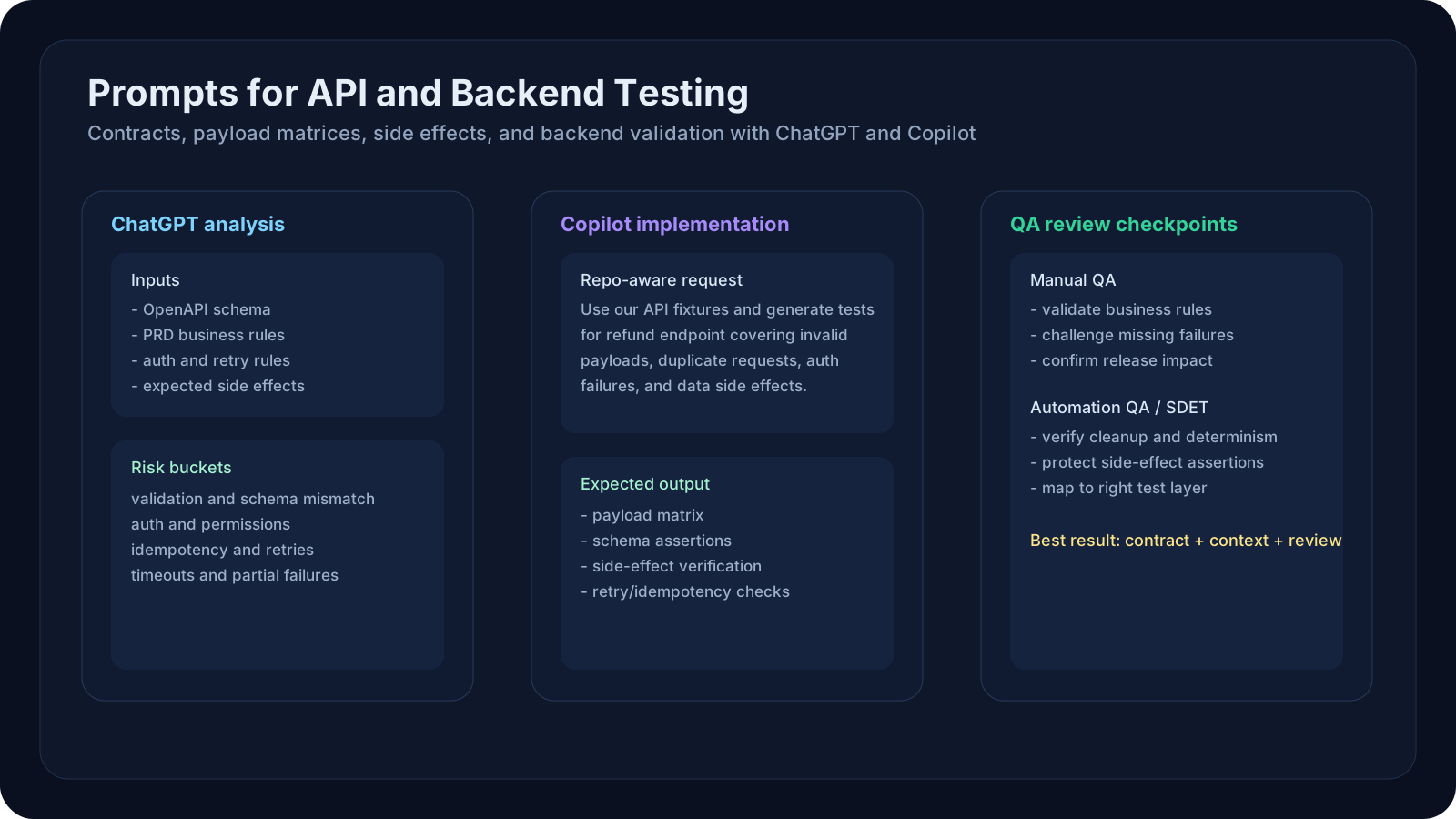
Overview
API testing prompts need more discipline than general test-case prompts. Backend systems have contracts, side effects, retries, permissions, and data integrity rules that AI will happily ignore unless you ask with precision.
This lesson shows how to use ChatGPT and Copilot for API and backend testing in a way that supports both manual QA and automation engineers.
A Practical Note for QA Learners
If you want the short version, remember this:
- provide the API contract
- provide the business invariant
- ask for side effects, not only status codes
- never trust generated backend tests unless you can explain what data changes underneath
Learning Goals
- Generate better endpoint-wise test matrices from API specs and PRD flows.
- Use ChatGPT for backend risk discovery and Copilot for repo-aware implementation help.
- Create prompts for auth, validation, idempotency, retries, and side effects.
- Generate test data and payload combinations that target real backend risk.
- Produce outputs that are usable for Postman, contract testing, or code-based API automation.
Core Concepts
1. Backend Prompts Need More Than Swagger
Helpful inputs:
- endpoint path and method
- request schema
- response schema
- auth rules
- validation rules
- rate limits
- business invariants
- side effects
- event or queue behavior if relevant
2. Ask About State Changes Explicitly
Weak prompts ask:
- "What status code should I test?"
Strong prompts ask:
- "What record should be created, updated, or not updated?"
- "What happens if the request is retried?"
- "What happens if a downstream dependency is slow?"
3. Use Risk Buckets
For backend prompts, force categories like:
- request validation
- authentication
- authorization
- business-rule rejection
- concurrency
- idempotency
- timeout and retry behavior
- partial failure
- data integrity
- audit trail
4. Ask for Test Data as Payload Sets
Rather than asking only for test cases, ask for:
- valid payload set
- invalid payload set
- boundary payload set
- malicious or abuse payload set
- conflicting state payload set
When to Use ChatGPT vs Copilot
| Task | ChatGPT | Copilot / GitHub Copilot Chat | Why |
|---|---|---|---|
| Analyze an API PRD or endpoint description | Strong | Medium | ChatGPT is better for broader risk reasoning |
| Generate payload matrices | Strong | Strong | Both work if schema is explicit |
| Compare endpoint behavior against business rules | Strong | Medium | Better for narrative reasoning |
| Generate repo-aligned API tests | Medium | Strong | Copilot sees test framework and helpers |
| Suggest fixture data from existing code | Medium | Strong | Copilot has local context |
| Explain side effects and missing assertions | Strong | Strong | Both are useful with enough context |
Prompt Pattern: From API Spec to Test Pack
Step 1: Ask for Risk Extraction
1You are a senior API QA engineer.23Given this endpoint specification, identify:4- validation rules5- auth rules6- business invariants7- likely side effects8- failure risks9- missing or ambiguous behavior1011Do not generate tests yet.12Return:13- endpoint summary14- risk areas15- missing informationStep 2: Ask for Structured Test Cases
1Generate test cases for this API.23Required coverage:4- valid requests5- invalid requests6- auth failures7- permission failures8- boundary values9- duplicate submissions10- retry/idempotency behavior11- side effects and data verification1213Return columns:14ID | Category | Preconditions | Request | Expected Response | Expected Side Effects | Priority | Automation CandidateChatGPT Examples for Manual QA
Example 1: Endpoint Risk Review from PRD
Use ChatGPT to ask:
1We are adding POST /orders/refund.2Based on this PRD, what backend risks should QA consider before writing cases?3Focus on authorization, refund amount rules, duplicate refund attempts, and audit logging.Example 2: Business Rule Gap Detection
Prompt:
1List the refund rules that are implied but not fully specified.2Do not invent policy. Flag missing rules as open questions.Example 3: Payload Boundary Generation
Ask for:
- zero values
- max field lengths
- special characters
- null and missing fields
- stale identifiers
Example 4: State Transition Thinking
Prompt:
1Generate test scenarios where an order moves between eligible and ineligible refund states.2Show what the expected API behavior should be at each state.Example 5: Side-Effect Checklist
Prompt:
1For each refund API scenario, add the expected database, ledger, notification, and audit-log side effects.Copilot Examples for Automation QA / SDET
Example 6: Postman Test Skeletons
Inside the IDE:
1Using our existing Postman collection style, generate tests for POST /orders/refund.2Reuse the naming pattern and assertion helpers already present in this repo.Example 7: Playwright APIRequestContext Spec Draft
1Create Playwright API tests for the refund endpoint using our current fixtures and auth helpers.2Cover valid, invalid, duplicate, and unauthorized requests.Example 8: Contract Assertion Expansion
1Review this generated API spec test and suggest missing assertions for response schema, business flags, and nested fields.Example 9: Fixture-Aware Payload Generation
1Look at our existing factories for orders and payments.2Propose 12 payload variations for refund testing, including boundary and conflicting state combinations.Example 10: Idempotency Test Support
1Generate an automation outline to verify idempotency for the refund endpoint.2Include request replay, repeated keys, and data verification after both calls.Practical Use Cases
Example 11: Test Data Generation for Backend Flows
Generate:
- expired tokens
- wrong tenant IDs
- partially valid payloads
- duplicate request IDs
- large but legal payload bodies
Example 12: PRD to API Scenario Mapping
Use ChatGPT to turn user-facing requirements into backend checks:
- user sees refund status update
- API writes refund record
- event is emitted
- balance changes exactly once
Example 13: Permission Matrix
Prompt:
1Generate a role-based test matrix for this endpoint.2Roles: customer, support_agent, finance_admin, internal_service.3Show allowed, denied, and conditionally allowed actions.Example 14: Negative Response Coverage
Prompt:
1Generate only negative API scenarios.2Include malformed payloads, stale resources, invalid auth, wrong state, retry conflicts, and downstream dependency failure.Example 15: Error Contract Verification
Ask the model to ensure:
- error code
- message pattern
- field-level error location
- trace or correlation ID behavior
Example 16: Manual QA Endpoint Review Pack
Use ChatGPT to produce:
- quick endpoint summary
- risk categories
- top 15 cases
- unanswered product questions
This is useful before a QA planning meeting.
Example 17: Automation Regression Matrix
Use Copilot to create:
- smoke API cases
- extended regression API cases
- reusable helper structure
Example 18: Service Integration Failure Path
Prompt:
1Assume this endpoint depends on an inventory service and a notification service.2Generate test scenarios for timeout, partial success, retry, and eventual consistency concerns.Example 19: Database Validation Planning
Ask:
1For each successful API request, list the backend entities and fields that should be verified in the database or event log.Example 20: Release-Readiness Summary
Prompt:
1Summarize the highest backend risks that remain untested for this API.2Return a release-readiness note for QA and engineering leads.Example Prompt Set for a Real QA Workflow
ChatGPT Prompt: Analyze the PRD
1Act as a senior QA engineer.23We are launching an API that creates subscription upgrades.4Read the PRD below and identify:5- business rules6- hidden edge cases7- risky dependencies8- missing error-handling expectations9- test data needs1011Then suggest the top 20 backend test scenarios.Copilot Prompt: Turn the Final Cases into Code-Aligned Assets
1Using the approved subscription-upgrade scenarios, generate a new Playwright API test file.2Follow our existing auth setup, test naming convention, and fixture style.3Do not invent helper names if they do not already exist.Manual QA Perspective
Manual QA gains:
- better planning before API tools are even opened
- clearer business-rule questioning
- better coverage in triage and review sessions
Manual QA should pay close attention to:
- missing rules in docs
- contradictions between UI and backend behavior
- workflow conditions that AI assumes but the business never defined
Automation QA / SDET Perspective
Automation teams gain:
- faster payload ideation
- stronger auth and side-effect coverage
- better contract validation prompts
- easier traceability from requirement to automated API test
Automation teams still need to own:
- framework design
- test isolation
- reliable setup and cleanup
- deterministic assertions
- environment safety
Hands-On Lab
Lab: API Regression Pack from Requirements
Choose one production or staging API and create:
- endpoint summary
- open questions
- 30 test cases
- 15 payload variations
- role-based access matrix
- side-effect verification checklist
- automation shortlist
Suggested flow:
- Use ChatGPT to extract risks and generate the first pass.
- Review it manually and cut anything invented or duplicated.
- Use Copilot to transform the final approved cases into your automation format.
- Mark what still requires exploratory or environment-specific testing.
Reflection Questions
- Which missing spec detail caused the largest risk to test quality?
- Which generated payloads were directly usable?
- Which AI outputs looked correct but ignored backend side effects?
- What should become part of your team's standard API prompt template?
Recommended Resources
- GitHub Copilot documentation
- Microsoft Copilot documentation
- OpenAI prompt engineering guide
- Postman testing guides
- Microsoft API design best practices
- OWASP API Security Top 10
Key Takeaways
- Backend prompts need contracts, invariants, and side effects to be useful.
- ChatGPT is strong for backend risk reasoning and requirement interpretation.
- Copilot is strong for turning approved scenarios into repo-aware test assets.
- Good API prompts ask about state transitions, retries, and data changes, not only response codes.
- Payload and test-data generation is part of backend testing quality.
- Human review remains the control point for domain correctness and production safety.
Next Step
Continue to Prompts for UI Automation for selector discipline, resilient assertions, and flake-aware prompt design.