Few-Shot and Example-Driven Prompts
Use high-quality examples to improve output consistency, tone, structure, and coverage for QA workflows.
Overview
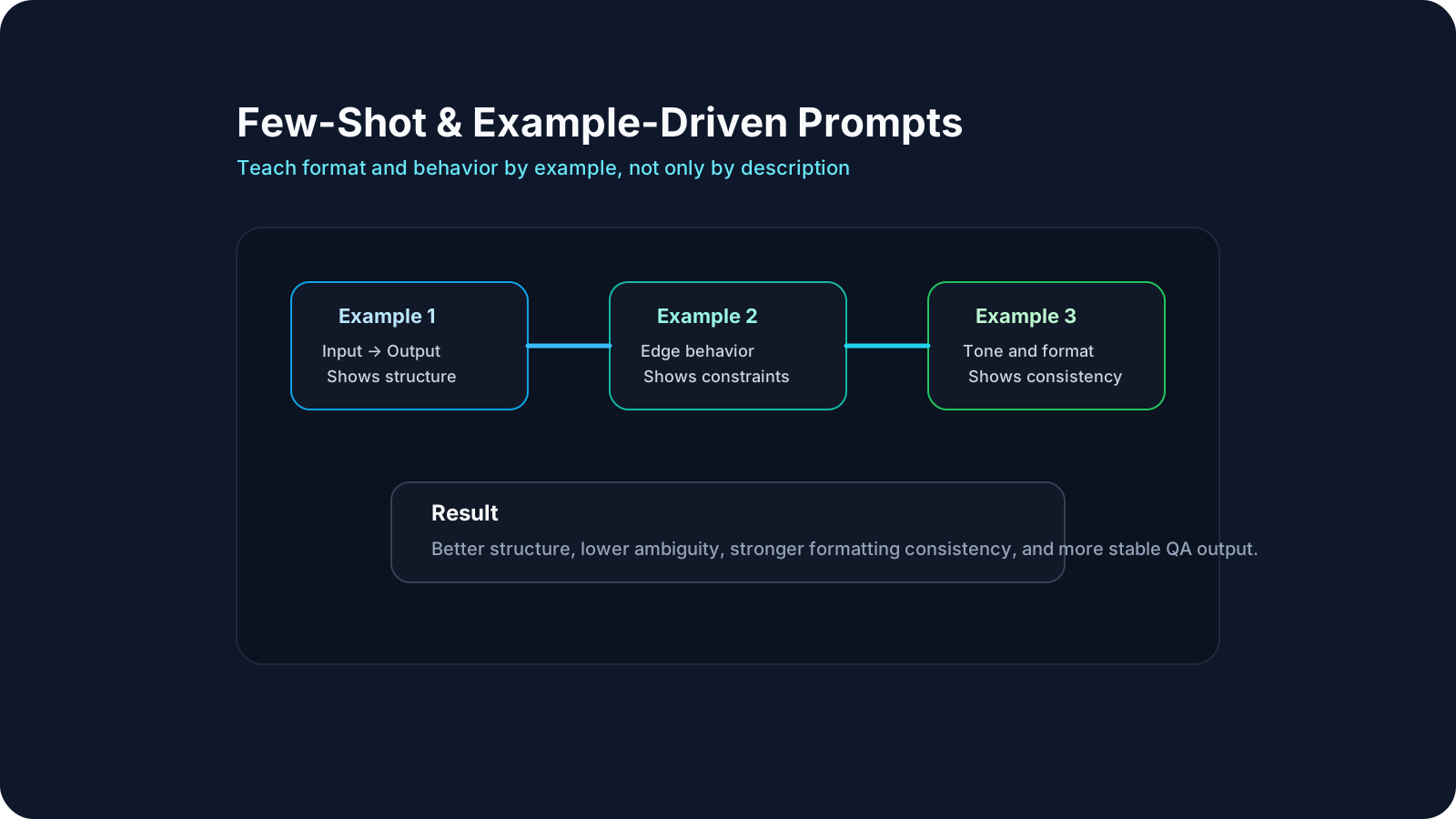
Few-shot prompting teaches by example. Instead of only telling the model what you want, you demonstrate it. This often improves structure, tone, consistency, and edge-case handling, especially when tasks are format-sensitive or domain-specific.
For QA teams, few-shot prompting is useful when basic instructions still produce unstable formatting, weak coverage, shallow defect summaries, or inconsistent categorization.
Learning Goals
- Understand why examples improve output reliability.
- Choose better examples for few-shot prompts.
- Avoid narrow or misleading examples.
- Compare zero-shot and few-shot behavior in QA tasks.
- Build reusable few-shot patterns for prompt libraries.
Core Concepts
1. Why Few-Shot Prompting Works
Examples reduce ambiguity in:
- format
- tone
- detail level
- category boundaries
- acceptable reasoning style
They make expectations concrete.
2. Zero-Shot vs Few-Shot
Zero-shot means you describe the task without examples. Few-shot means you include one or more input/output examples before the real task.
Few-shot is useful when:
- format is strict
- output style matters
- domain language is specialized
- simple instructions still underperform
3. What Makes a Good Example
Good examples should be:
- realistic
- concise
- representative
- aligned with the desired output structure
- strong enough to teach the pattern without adding noise
Bad examples are vague, contradictory, too narrow, too long, or inconsistent.
4. Example Diversity Matters
Useful diversity can include:
- one easy case
- one edge case
- one invalid or failure case
- one format-sensitive case
That helps the model generalize the pattern instead of copying one rigid template.
5. Where Few-Shot Helps Most in QA
| Use case | Why few-shot helps |
|---|---|
| BDD scenario generation | Teaches exact scenario structure |
| Defect severity classification | Teaches category boundaries |
| API assertion templates | Teaches consistent format |
| Risk-based test generation | Teaches expected coverage depth |
| JSON output generation | Teaches exact field shape |
6. Common Few-Shot Failure Modes
| Failure mode | Example |
|---|---|
| Overfitting to example shape | Model copies wording too literally |
| Example contradiction | Different examples imply conflicting rules |
| Too much example text | Context budget is wasted |
| Weak example quality | Model imitates poor structure |
| Missing edge coverage | Model learns only easy cases |
QA/SDET Relevance
Manual QA benefits:
- more stable exploratory charters
- clearer triage summaries
- better classification consistency
Automation and SDET benefits:
- stronger structured outputs
- better repeatability across reruns
- more reliable prompt templates for CI
Practical Work
Exercise: Zero-Shot vs Few-Shot Lab
Choose one task:
- BDD scenario generation
- defect severity classification
- API assertion generation
Run three versions:
- zero-shot prompt
- 2-example few-shot prompt
- 5-example few-shot prompt
Measure:
- format consistency
- coverage depth
- hallucination rate
- usefulness for QA review
Reflection
- Which version produced the most useful output?
- Did more examples always help?
- Which examples taught the model the most important pattern?
Recommended Resources
Key Takeaways
- Few-shot prompting teaches by demonstration, not only by instruction.
- Example quality matters more than example quantity.
- A small number of strong examples often beats many weak ones.
- QA teams should test whether examples improve consistency without narrowing coverage too much.
- Few-shot prompting is especially useful when output structure matters.
Next Step
Continue to Structured Output and JSON Mode to make model outputs safer for automation pipelines.