Structured Output and JSON Mode
Design prompts that produce machine-validated structured outputs for reliable automation pipelines.
Overview
Automation-friendly prompting requires strict output contracts. Natural language can be useful for humans, but automation pipelines need outputs that can be parsed, validated, and trusted.
This lesson explains how to design schema-first prompts, reduce parse errors, and add validation gates so AI-generated output is safe to use in engineering workflows.
A Practical Note for QA Learners
If you want AI outputs to feed tests, scripts, or CI pipelines, this topic matters a lot. The model should not just sound structured. It should actually produce output your systems can validate and use.
Learning Goals
- Define schema-first prompts for automation workflows.
- Reduce parse errors with clearer constraints.
- Understand when JSON is better than free-form prose.
- Add validation gates and fallback behavior to pipelines.
- Measure structured-output reliability as a QA metric.
Core Concepts
1. Why Structured Output Matters
Structured outputs are useful when:
- output feeds a script
- data must be parsed automatically
- fields are required
- downstream validation matters
2. Schema-First Prompting
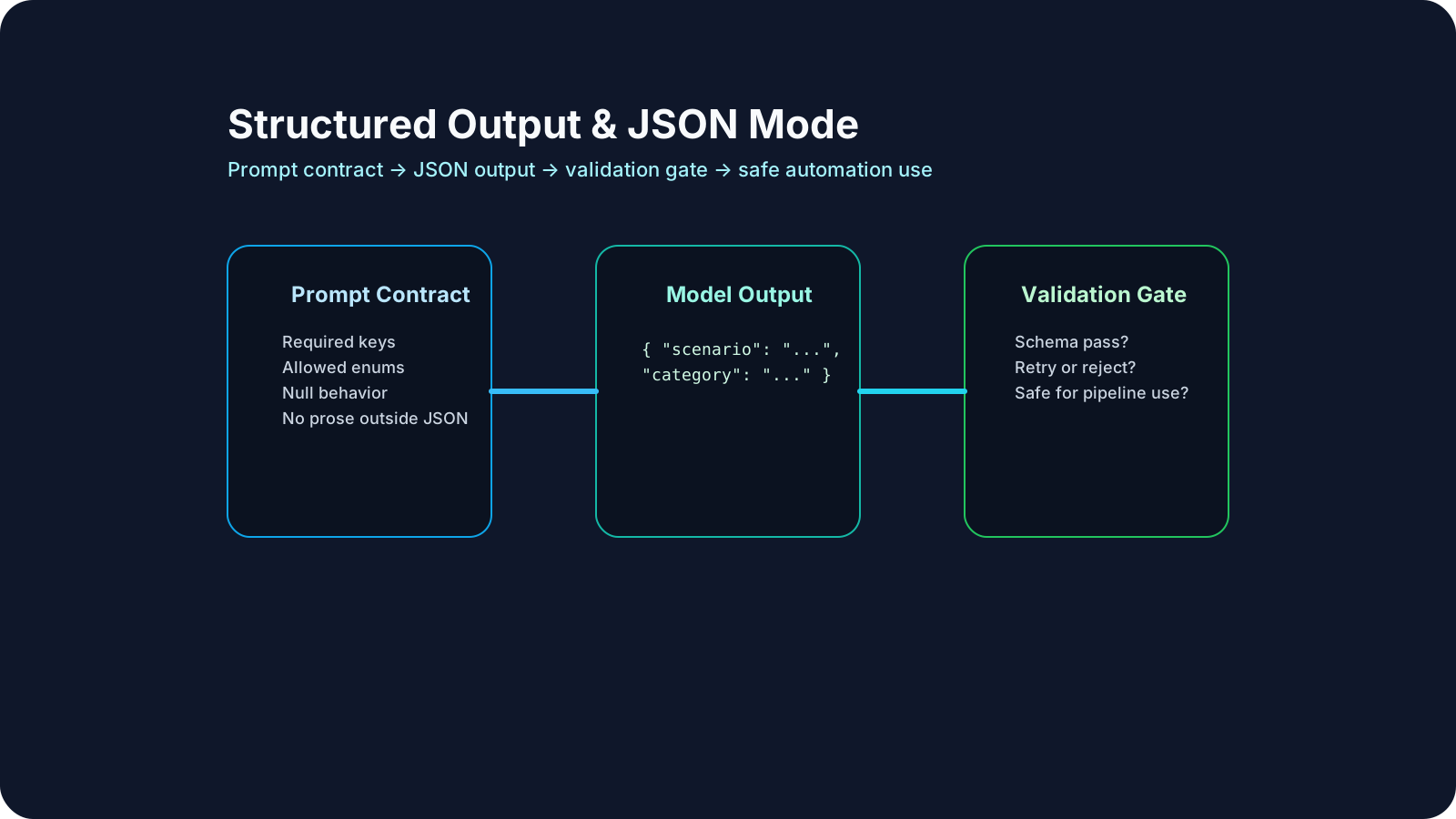
Good schema-first prompts define:
- required fields
- field types
- allowed enums
- null behavior
- no extra prose
Example:
1Return JSON only.2Each item must contain:3- id (string)4- scenario (string)5- category (enum: positive, negative, boundary, security)6- expected_result (string)7If a field is unknown, use null.8Do not include explanations outside the JSON.3. Prompting Is Not Enough Without Validation
Even with good prompts, models can still:
- omit fields
- add unexpected prose
- use the wrong enum value
- produce malformed JSON
That is why structured prompting should be paired with schema validation, retry logic, rejection rules, and fallback handling.
4. JSON Reliability Patterns
Useful patterns:
- return JSON only
- specify required keys explicitly
- specify enum values explicitly
- define missing-data behavior
- keep the output shape simple
Avoid asking for JSON and also a friendly explanation in the same output.
5. Validation Pipeline
Typical safe flow:
- model output
- schema validator
- retry or reject on failure
- only then pass to downstream automation
Useful metrics:
- parse pass rate
- schema pass rate
- retry rate
- invalid enum rate
QA/SDET Relevance
Manual QA benefits:
- clearer machine-reviewable outputs
- easier comparison across runs
Automation and SDET benefits:
- safer pipeline integration
- easier CI validation
- lower risk of brittle downstream parsing
Practical Work
Exercise: JSON Reliability Lab
Create a prompt that generates API test cases as JSON.
Required fields:
- id
- scenario
- category
- expected_result
Run it 50 times with varied inputs and measure:
- parse pass rate
- schema pass rate
- retry count
- format drift
Reflection
- Which prompt change improved schema pass rate the most?
- Did stricter constraints reduce useful detail?
- What fallback should happen when validation fails?
Recommended Resources
Key Takeaways
- Structured output is essential when AI feeds automation.
- Prompt constraints help, but validators are still required.
- Schema pass rate is a practical QA metric.
- Clear contracts reduce downstream failures.
- Safe automation needs both prompting discipline and validation discipline.
Next Step
Continue to Prompt Testing and Evaluation Metrics to learn how to measure prompt quality systematically.