Prompt Testing and Evaluation Metrics
Measure prompt quality with reproducible evaluation sets, rubrics, regression checks, and release thresholds.
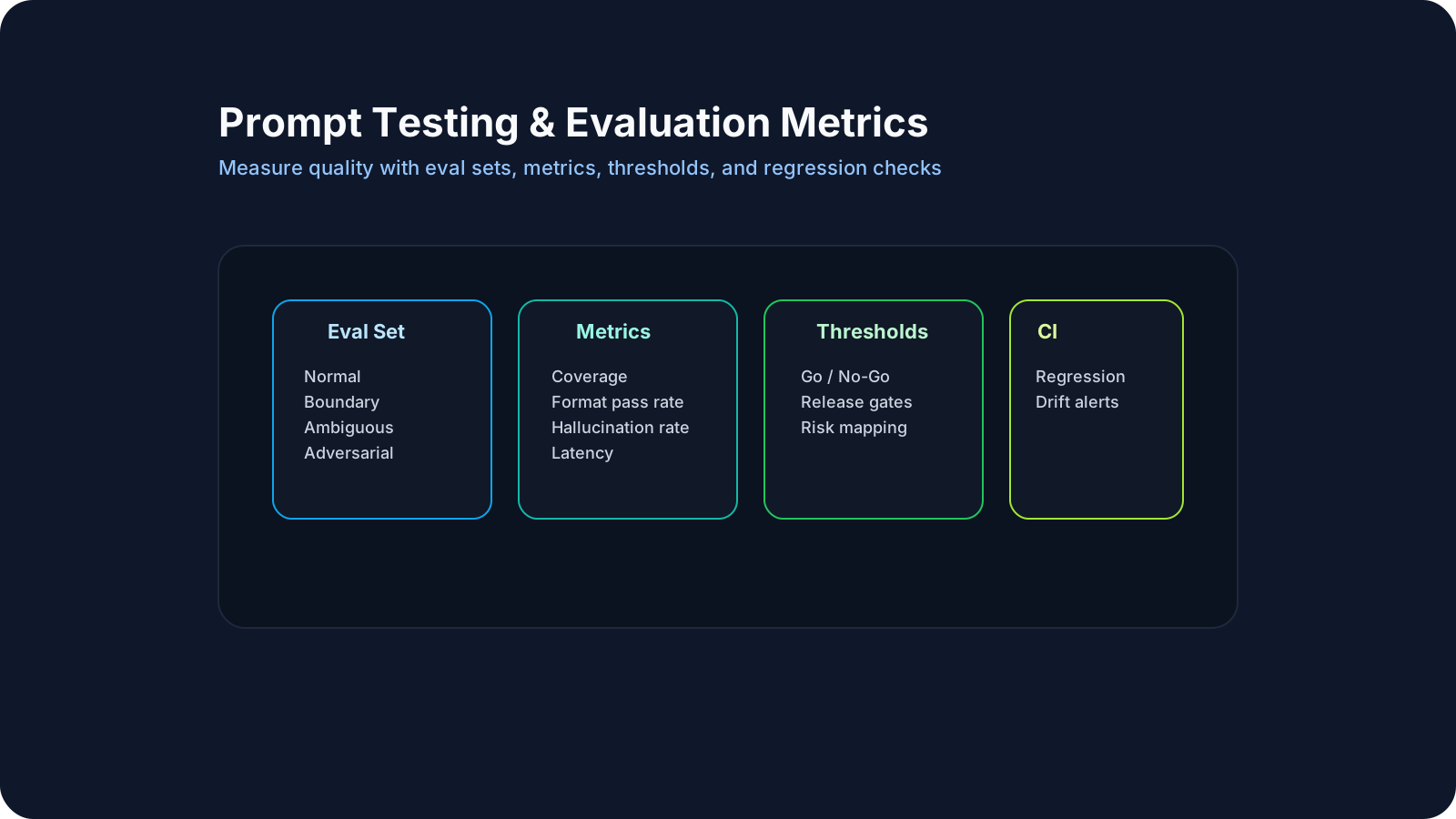
Overview
If you cannot measure prompt quality, you cannot improve it reliably. Prompt engineering only becomes an engineering discipline when outputs are evaluated against stable datasets, meaningful metrics, and release thresholds.
This lesson explains how QA teams can build practical prompt evaluation systems that are reproducible, risk-based, and useful in real delivery pipelines.
A Practical Note for QA Learners
This lesson matters because prompt tuning without evaluation becomes opinion-driven very quickly.
For practical QA work:
- define the cases that matter
- choose metrics tied to real product risk
- compare results after every prompt change
Learning Goals
- Build a prompt evaluation dataset.
- Define useful metrics for prompt quality.
- Set thresholds that map to actual release risk.
- Run regression checks after prompt or model changes.
- Turn prompt testing into a repeatable QA activity.
Core Concepts
1. Why Prompt Evals Matter
Without evaluation, teams often judge prompts by:
- one successful output
- informal demos
- personal preference
- short-term convenience
That is not enough for production use.
Prompt evals help answer:
- does the prompt cover the right cases?
- does it fail safely?
- is quality stable over time?
- did the last change improve or degrade behavior?
2. Eval Set Design
A useful eval set should include:
- normal cases
- boundary cases
- ambiguous cases
- adversarial cases
- failure-recovery cases
For QA workflows, examples might include:
- short clean requirement
- long noisy requirement
- incomplete ticket
- conflicting business rules
- prompt injection attempt
3. Metric Selection
Metrics should map to product risk rather than vanity.
| Metric | Why it matters |
|---|---|
| Coverage score | Did the output use the provided rules? |
| Format pass rate | Can downstream systems parse the output? |
| Hallucination rate | How often does the model invent unsupported content? |
| Robustness score | Does quality hold under paraphrase and noise? |
| Latency | Does the workflow remain practical and stable? |
4. Rubrics vs Exact Matching
For many prompt tasks, exact string matching is too strict and not very meaningful.
Better choices include:
- rubric scoring
- schema validation
- property-based checks
- groundedness checks
- human review for high-risk cases
Use exact matching only when:
- output is tightly constrained
- fields are fixed
- determinism is expected
5. Thresholds and Release Gates
A metric is only useful if you know what counts as acceptable.
Examples:
- schema pass rate must stay above 98%
- hallucination rate must stay below 5% on gold-set tasks
- required coverage categories must never drop below target
These thresholds should reflect:
- user risk
- downstream automation dependency
- business criticality
6. Regression Strategy
Run the eval suite when:
- the prompt changes
- the model changes
- retrieval behavior changes
- output schema changes
- system instructions change
Regression checks should help catch silent quality drift before release.
QA/SDET Relevance
Manual QA benefits:
- clearer evidence for prompt quality claims
- better risk communication during release review
Automation and SDET benefits:
- CI-based prompt checks
- measurable release gates
- easier comparison across model or prompt versions
Practical Work
Exercise: Build a 30-Case Prompt Eval Set
- Choose one important prompt workflow.
- Create 30 cases:
- 10 normal
- 5 boundary
- 5 ambiguous
- 5 noisy
- 5 adversarial
- Define 3 key metrics.
- Set go/no-go thresholds.
- Compare results across 2 prompt versions.
Reflection
- Which metric best reflected real user risk?
- Which cases caught regressions fastest?
- What should block release immediately?
Recommended Resources
Key Takeaways
- Evals turn prompt tuning into engineering.
- Metrics should reflect product risk, not just convenience.
- Regression gates prevent silent prompt-quality drift.
- Strong eval sets include normal, edge, ambiguous, and adversarial cases.
- Prompt quality should be measured before and after every meaningful change.
Next Step
Continue to Prompt Security and Injection Defense to strengthen prompt workflows against deliberate misuse and unsafe behavior.